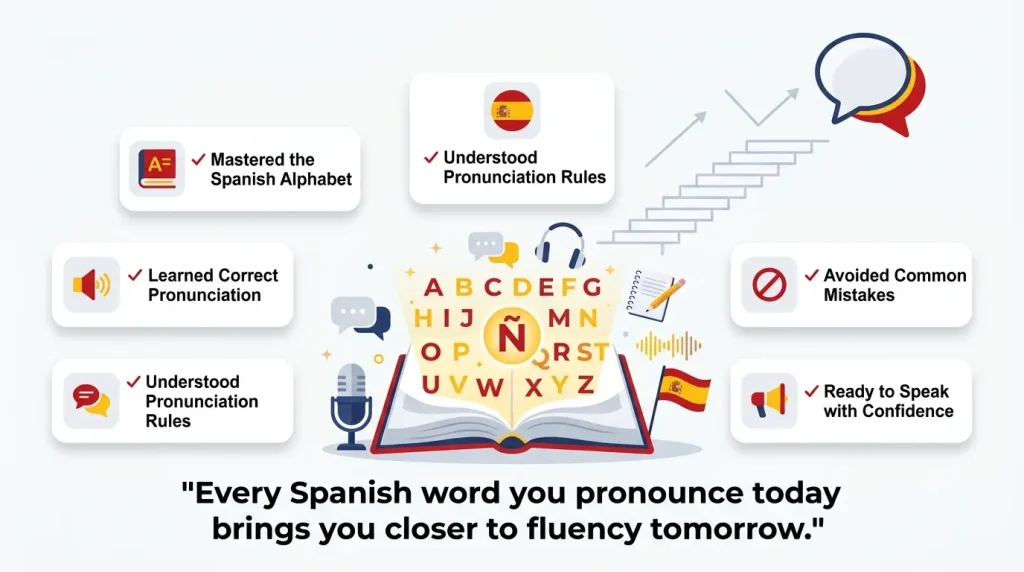
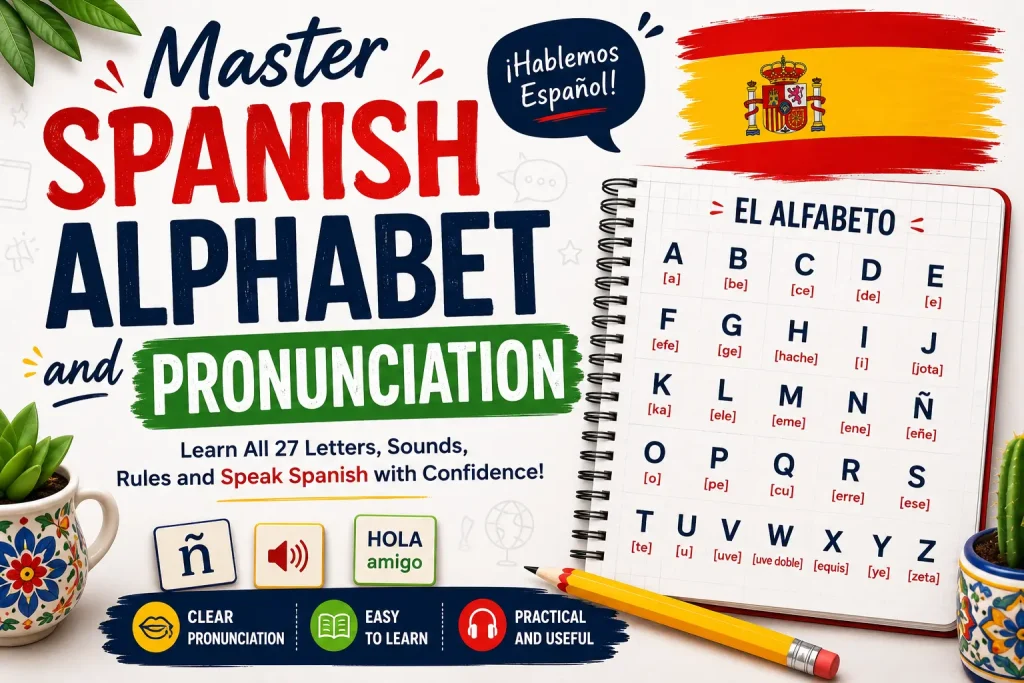
Spanish alphabet and pronunciation are the key foundations to speak Spanish with confidence and fluency. Have you ever watched La Casa de Papel or La Reina del Sur, and found yourself understanding very little, yet wondering how native speakers talk so effortlessly? Then, you ask a question that almost every beginner does “Will I ever be able to speak Spanish that naturally?”
The answer is yes. If you’re an English speaker, learning Spanish pronunciation is often easier than you might expect. Some letters may sound different from English, but Spanish follows clear and consistent pronunciation rules, which means most letters are pronounced the same way every time.
Once you understand these sounds, reading Spanish words, speaking with confidence becomes much more easier. In this guide, you will learn the Spanish alphabet, master its pronunciation, and build a strong foundation for your Spanish learning journey.
In this guide, you’ll learn everything you need to know about Spanish alphabet and pronunciation, from the 27 letters to essential pronunciation rules and common beginner mistakes.
Why Learning the Spanish Alphabet and Pronunciation Is Important For Beginners?

When someone starts to learn Spanish, they generally want to jump directly learning vocabulary as well as grammar, but in all that excitement, many beginners skip to learn basic Spanish alphabet and pronunciation. It may seem like a small step, but it’s the foundation of speaking Spanish with confidence.
Imagine you know a word and it’s meaning but you cannot use it in a conversation because you do not know how to pronounce it. When you understand how each Spanish alphabet sound it will become easy for you to read words and even make words on your own. Since Spanish follows consistent pronunciation rules, mastering the alphabets will make every new word and sentence easier to understand.
Instead of memorizing the pronunciation of every new word, you should start to recognize it’s patterns and naturally understand how Spanish words are spoken. That’s why taking a little time to learn the Spanish alphabet and pronunciation will save you a lot of confusion as you continue your Spanish learning journey.
How Many Letters Are There in the Spanish Alphabets?

If someone tells you that learning the Spanish alphabets is much more easier than learning the English alphabet, would you believe them? But surprisingly, it’s true. While both languages share most of the same letters, Spanish has a much simpler pronunciation. It means once you learn how each letter sounds, you won’t have to keep guessing the pronunciation of every new word you come across.
Like in English, pronunciation of every alphabet depends on the word but this don’t happen in Spanish. The modern Spanish alphabet according to Royal Spanish Academy (RAE) consists of 27 letters, with Ñ (eñe) being the only letter that doesn’t exist in the English alphabet.
You don’t need to memorize complicated pronunciation rules before you start reading Spanish. Once you are familiar with these 27 letters and the sounds they make, you will notice that most Spanish words are pronounced exactly the way they are written. That’s one of the biggest reasons beginners often find Spanish easier to read than English.
Spanish Alphabet Chart with Pronunciation

Now you know there are 27 letters in Spanish, it’s time to understand their pronunciations. Mastering the Spanish alphabet and pronunciation is much easier than most beginners expect. Spanish alphabets looks exactly same as English ones which often makes beginners think they will be pronounced in similar way. However, that’s not true. While some letters share similar sounds, others—such as J, Ñ, R, and RR have completely different pronunciations.
But unlike English, where the pronunciation of a letter can change depending one word to word, Spanish is much more consistent. Once you learn the sound of each letter, you will be able to pronounce thousands of Spanish words with much more confidence. Use the chart below as your quick reference whenever you come across a new word.
| Letter | Spanish Name | Pronunciation | Example |
| A | a | ah | amigo[friend] |
| B | be | beh | bueno [good] |
| C | ce | seh (before E/I), keh (before A/O/U) | casa[house] cena[dinner] |
| D | de | deh | día [day] |
| E | e | eh | elefante[elephant] |
| F | efe | eh-feh | familia[family] |
| G | ge | heh (before E/I), geh (before A/O/U) | gato[cat] gente[people] |
| H | hache | silent | hola[hello] |
| I | i | ee | isla[island] |
| J | jota | ho-ta (strong “h” sound) | jardín[garden] |
| K | ka | kah | kilómetro [kilometer] |
| L | ele | eh-leh | libro[book] |
| M | eme | eh-meh | manzana[apple] |
| N | ene | eh-neh | noche[night] |
| Ñ | eñe | en-yeh | niño[boy] |
| O | o | oh | oso[bear] |
| P | pe | peh | papel[paper] |
| Q | cu | kuu | queso[cheese] |
| R | erre | Soft rolled R | rojo[red] |
| S | ese | eh -seh | sol[sun] |
| T | te | teh | tiempo[time] |
| U | u | oo | uno[one] |
| V | uve | oo-beh (similar to B) | vino[wine] |
| W | uve doble | oo-beh doh-bleh | wifi |
| X | equis | eh-kees | éxito[success] |
| Y | ye | ye | yo[i] |
| Z | zeta | seh-tha (Spain), seh-sa (Latin America) | zapato[shoe] |
Spanish Vowels: The Foundation of Spanish Alphabet and Pronunciation
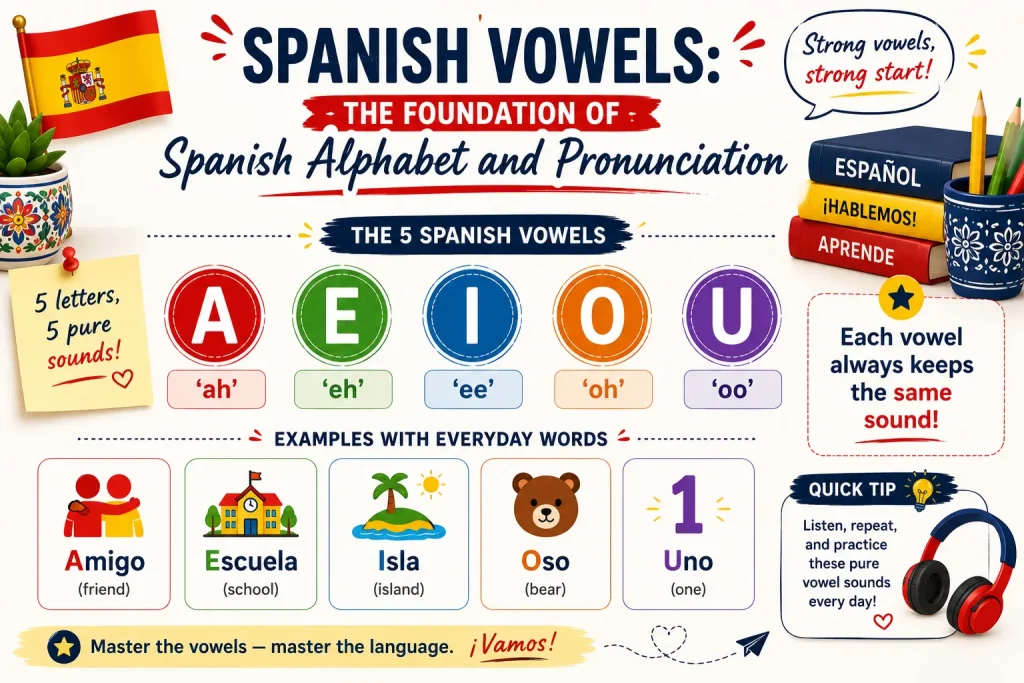
If someone wants to master Spanish Alphabet and Pronunciation then they should focus on vowels. Just like English, Spanish also have 5 vowels. But the only difference between English and Spanish is that in English, where the same vowel can have multiple pronunciations, Spanish has only five vowels-A, E, I, O, and U and each one has a clear, consistent sound. This is one of the biggest reasons why many learners find Spanish easier to pronounce than English.
Think about English words like “cake,” “car,” and “call.” Even though they all contain the letter A, but is pronounced differently in each word. Spanish works differently. The vowel A always sounds like “ah,” whether it’s in amigo, casa, or gracias. The same consistency applies to the other four vowels, making it much easier to read new words correctly and naturally.
Since vowels appear in almost every word, mastering them is one of the fastest ways to improve your pronunciation and build confidence while speaking Spanish.
Spanish Consonants

Most of the consonants in the Spanish alphabets and pronunciation are similar to that of English, only some are pronounced differently. These letters often confuse beginners because they look familiar but produce completely different sounds.
The good news is that you don’t need to memorize every pronunciation rule at once. By understanding how a few important consonants work, you will be able to pronounce many everyday Spanish words more accurately. Pay extra attention to letters like C, G, H, J, LL, Ñ, R, and RR, as these are the ones that usually require a little extra practice.
Let’s take a closer look at each of these letters and learn how they’re pronounced with simple explanations and real-life examples.
1. Letter C
- C + A, O, U = K sound (casa, cosa, Cuba)
- C + E, I = S sound in Latin America / TH sound in most of Spain (cena, cinco)
2. Letter G
- G + A, O, U = hard G (gato)
- G + E, I = throaty H sound (gente, gimnasio)
3. Letter H
- Always silent (hola, hospital)
4. Letter J
- Strong breathy sound (jamón, jardín)
5. Letter LL
- Usually pronounced like Y in many regions (llave)
6. Letter Ñ
- Similar to ny in “canyon” (niño)
7.Letter R and RR
- Single R = soft tap (pero)
- Double RR = rolled sound (perro)
Essential Spanish Pronunciation Rules Every Beginner Should Know
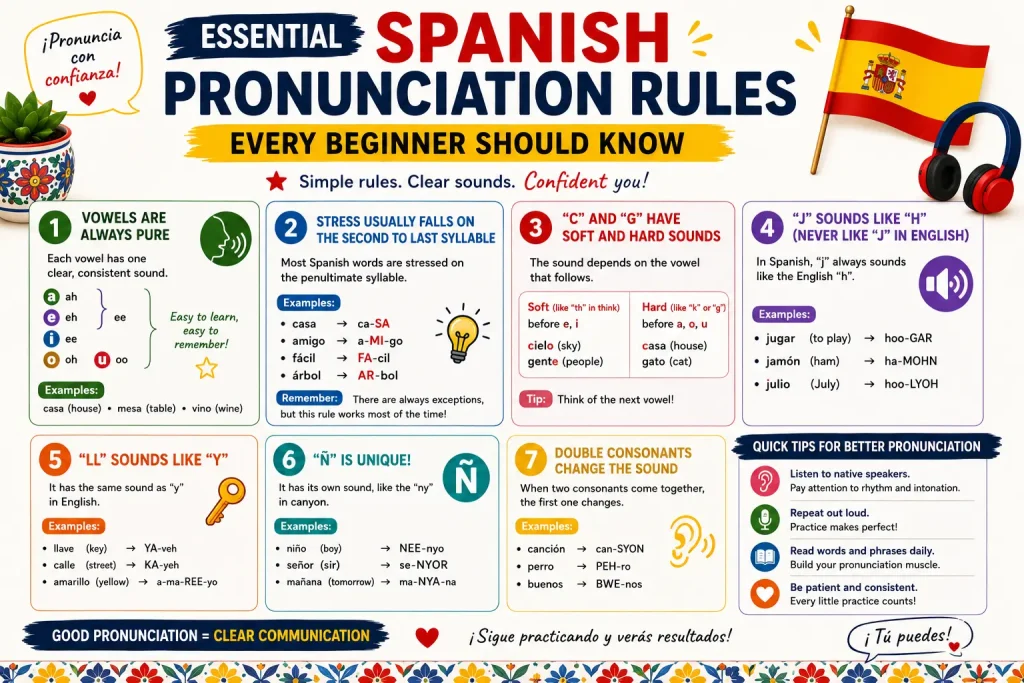
Learning individual letters is only the first step in mastering the Spanish alphabet and pronunciation. Now you know Spanish alphabets and how they pronounce. Spanish have consistent sounds and it do not vary word to word but there are exceptions always. Instead of memorizing every Spanish word individually, learning these pronunciation rules will help you read new words correctly and speak with greater confidence.
| Rule | Pronunciation | Example |
| C + A, O, U | K | casa, cosas, cultura |
| C + E, I | S (Latin America) or TH (Spain) | cena, cinco |
| G + A, O, U | Hard G sound | gato, gordo, gorila |
| G + E, I | Soft, throaty H sound | gente, gimnasio |
| H | silent | hola, hermano |
| Q + U | K | queso |
| B & V | Usually pronounced almost the same | bueno, vino |
| R | Soft tap between vowels | pero |
| RR | Strong rolled sound | perro, perra |
Common Spanish Pronunciation Mistakes Beginners Should Avoid

While learning Spanish alphabet and pronunciation, we should avoid some mistakes. Many beginners accidentally apply English pronunciation rules to Spanish words, which can lead to confusion and make it harder for native speakers to understand them. But these mistakes can get better by doing practice.
One of the most common mistakes is pronouncing the letter H. In Spanish, H is always silent, so words like hola and hospital are not pronounced the same way they would be in English. Another frequent mistake is pronouncing the letter J like the English “J” in job. In Spanish, J is pronounced like jamón and jardín.
One of the most important thing in Spanish is accent marks. They are not just decorative symbols, they help indicate which syllable should be stressed. Paying attention to these small details can make a big difference in your pronunciation and overall confidence when speaking Spanish.
Tips to Improve Your Spanish Alphabet and Pronunciation

Mastering the Spanish alphabet and pronunciation doesn’t happen overnight, but with consistent practice, you will be able to improve the way you speak and understand Spanish. Here are a few simple tips that can help you improve your pronunciation faster:
- Listen to native speakers regularly.
- Read Spanish words aloud in front of mirror.
- Record yourself speaking.
- Practice consistently.
Frequently Asked Questions About Spanish Alphabet and Pronunciation
1. Is the Spanish alphabet the same as the English alphabet?
No. The Spanish alphabet has 27 letters, including Ñ, which is unique to Spanish. Learning the Spanish alphabet and pronunciation helps you understand these differences.
2. Is Spanish pronunciation easy to learn?
Yes. The Spanish alphabet and pronunciation follow consistent rules, making it easier for beginners to read and speak Spanish correctly.
3. What is the hardest letter to pronounce in Spanish?
Most beginners find RR, J, and Ñ the most challenging because these sounds don’t exist in English.
4. How can I improve my Spanish pronunciation?
Practice reading aloud, listen to native speakers, and review the Spanish alphabet and pronunciation regularly to build confidence.
5. Do accent marks affect pronunciation?
Yes. Accent marks show which syllable should be stressed, helping you pronounce Spanish words accurately.
Conclusion
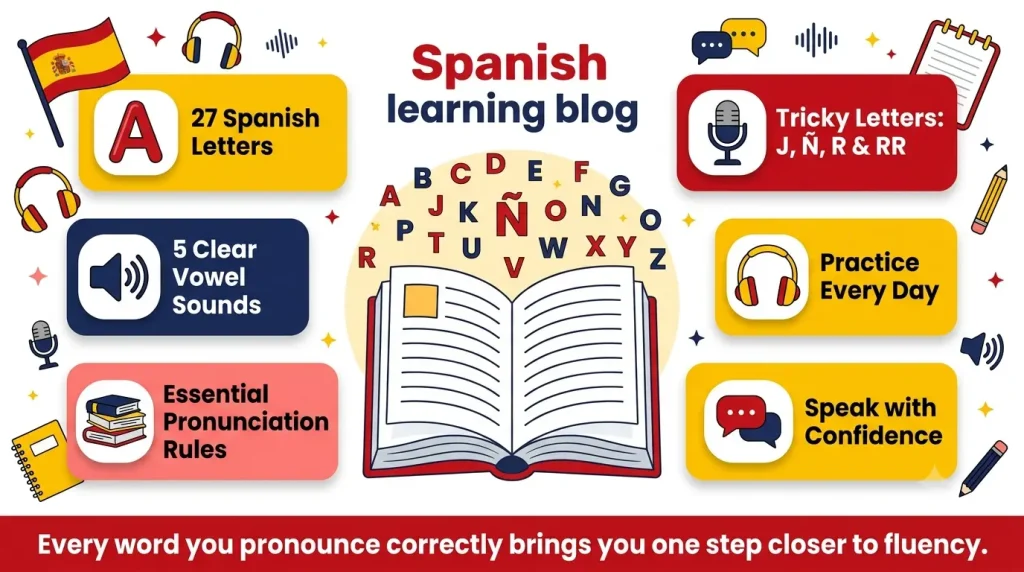
Mastering the Spanish alphabet and pronunciation is one of the foundation in your journey towards Spanish learning and speaking. Once you understand how each letter sounds and follow the basic pronunciation rules, reading, speaking, and listening become much easier.
You just need consistent practice to speak confidently and fluently. Now that you’ve learned the basics of the Spanish alphabet and pronunciation, keep practicing by reading simple Spanish words, listening to native speakers, and using what you’ve learned every day.
By practicing the Spanish alphabet and pronunciation every day, you will build a strong foundation that makes learning vocabulary, grammar, and conversations much easier. If you’re ready to continue your journey, explore our guides on Spanish Grammar Basics and Essential Spanish Vocabulary for Beginners to build an even stronger foundation.