
📚 Grammar Foundations
Spanish Grammar Foundations
Learn the building blocks of Spanish before mastering verbs and tenses.
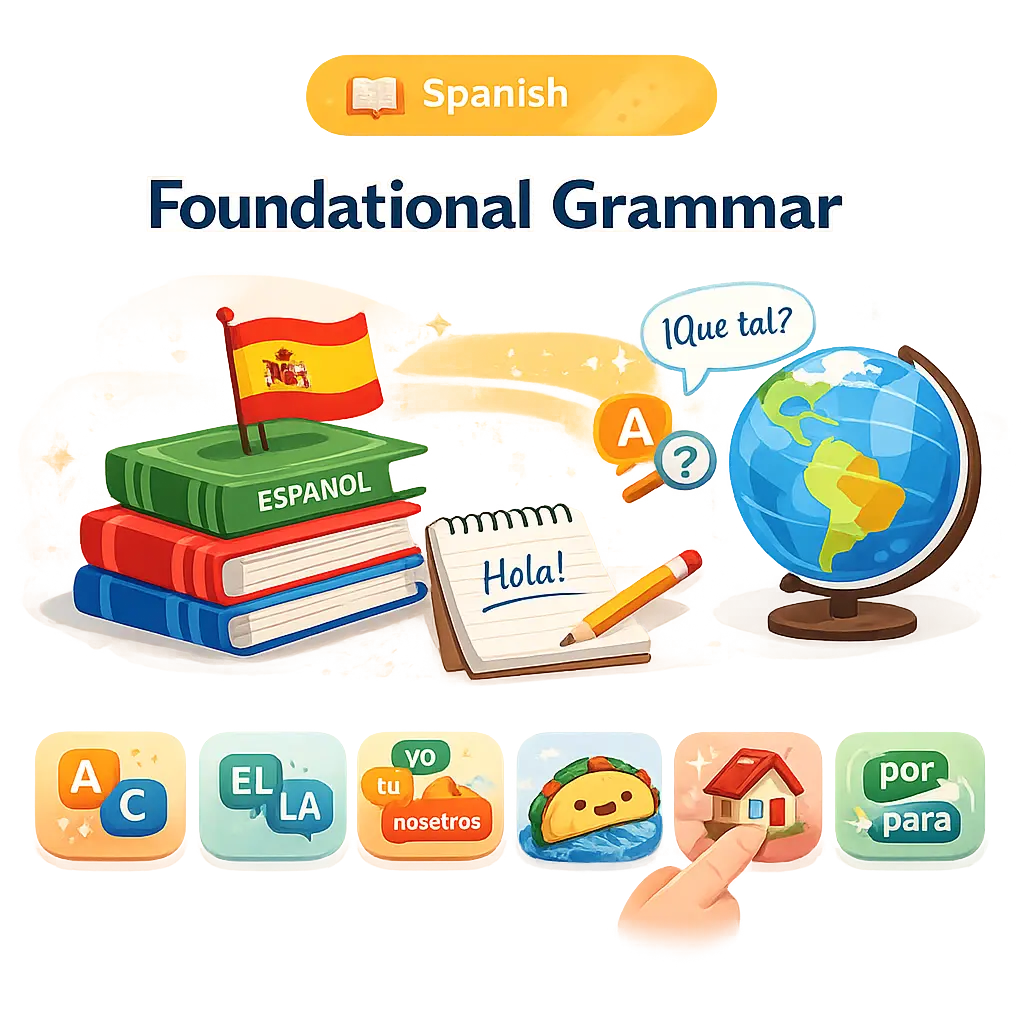
Why We Should Learn Spanish Grammar Foundations?
Every language has a foundation, and Spanish is no different. Before learning verb tenses, conversations, or advanced grammar, it’s important to understand the basic rules that shape the language. These concepts will help you read, write, and speak Spanish with greater confidence.
Quick Tip:-
Think of grammar foundations as the roots of a tree. Once you understand these basics, learning Spanish verbs, tenses, and conversations becomes much easier..
LEARNING ROADMAP
What You'll Learn
This guide covers essential building blocks of Spanish grammar. Learn them step by step before moving on to verbs and tenses.
Alphabet & Pronunciation
Learn Spanish letters, sounds, accent marks, and pronunciation rules to build confident reading and speaking skills.
Gender & Articles
Understand masculine and feminine nouns, articles, and how they agree with different words.
Pronouns
Learn how Spanish replaces nouns using subject, object, reflexive, and possessive pronoun.
Adjectives
Discover how adjectives describe nouns and change to match gender and number.
Sentence Structure
Learn the correct word order and build simple, accurate Spanish sentences.
Prepositions & Conjunctions
Connect words and ideas naturally using the most common Spanish prepositions and conjunctions.
Let's Begin Your Spanish Grammar Journey
LESSON.1
Alphabet & Pronunciation
Spanish is one of the easiest languages to pronounce because most words are read exactly as they are written. Once you learn the alphabet and pronunciation rules, you will be able to read thousands of Spanish words with confidence.
Spanish has 27 letters, including Ñ, and follows consistent pronunciation rules, making it easier to read than English.
| Letter | Pronunciation |
|---|---|
| A a | ah |
| B b | beh |
| C c | seh / theh* |
| D d | deh |
| E e | eh |
| F f | efe |
| G g | heh |
| H h | ah-che |
| I i | ee |
| J j | hoh-ta |
| K k | kah |
| L l | ele |
| M m | eme |
| N n | ene |
| Ñ ñ | ehn-yeh |
| Letter | Pronunciation |
|---|---|
| O o | oh |
| P p | peh |
| Q q | koo |
| R r | eh-re |
| S s | ese |
| T t | teh |
| U u | oo |
| V v | oo-veh |
| W w | oo-veh doh-ble |
| X x | eh-kees |
| Y y | i griega |
| Z z | theh / seh* |
Accents (Tildes)
- A tilde (´) shows which syllable is stressed.
- It can also change the meaning of a word.
Examples
- sí = yes | si = if
- tú = you | tu = your
- él = he | el = the
LESSON.2
Gender And Articles
Gender (Género)
Every Spanish noun is either Masculine or Feminine.
General Rules
- Masculine → Usually ends in -o
- libro (book)
- niño (boy)
- Feminine → Usually ends in -a
- casa (house)
- niña (girl)
Common Exceptions
- el día → Masculine
- el mapa → Masculine
- la mano → Feminine
- la foto → Feminine
Tip: Learn nouns with their article (el or la) to remember the gender.
Articles (Artículos)
Articles come before a noun and indicate gender and number.
Definite Articles (The)
| Article | Use |
|---|---|
| el | Masculine Singular |
| la | Feminine Singular |
| los | Masculine Plural |
| las | Feminine Plural |
Examples
- el libro
- la casa
- los libros
- las casas
Indefinite Articles (A / An)
| Article | Use |
|---|---|
| un | Masculine Singular |
| una | Feminine Singular |
| unos | Masculine Plural |
| unas | Feminine Plural |
Examples
- un libro
- una casa
- unos libros
- unas casas
Subject Pronouns (Pronombres Personales)
What are Subject Pronouns?
Subject pronouns replace a noun and tell who is performing the action in a sentence. Instead of repeating a person’s name, we use pronouns such as yo, tú and el…..
María estudia español.
⬇
Ella estudia español.
Spanish Subject Pronouns
Yo | I |
Tu | You (informal) |
El | He (singular) |
Ella | She (singular) |
Usted | You (formal) |
Nosotros/as | We all |
Vosotros/as | You all |
Ellos | They (masculine plural) |
Ellas | They (feminine plural) |
Ustedes | You ( plural) |
Adjectives
Adjectives describe or give more information about a noun. In Spanish, adjectives agree with the noun’s gender and number. For example
El libro rojo.
(The red book.)

La casa roja.
(The red house.)
Gender Agreement
| Masculine | Feminine |
|---|---|
| rojo | roja |
| alto | alta |
| bonito | bonita |
| pequeño | pequeña |
Position of Adjectives
Most Spanish adjectives come after the noun.
Examples
- un coche nuevo (a new car)
- una casa grande (a big house)
- un perro negro (a black dog)
Note: Some adjectives (like buen, mal, primer) can come before the noun.
Basic Sentence Structure
Spanish usually follows the Subject + Verb + Object (SVO) order, just like English.
Example
Yo + hablo + español.
I speak Spanish.
| Spanish | English |
|---|---|
| Yo estudio español. | I study Spanish. |
| Ella lee un libro. | She reads a book. |
| Nosotros comemos pizza. | We eat pizza. |
| Ellos viven en Madrid. | They live in Madrid. |
Questions & Negatives
Negative Sentence
Place no before the verb.
Example
- Yo no estudio español.
- I do not study Spanish.
Question
Spanish questions usually keep the same word order.
Example
- ¿Hablas español?
- Do you speak Spanish?
Prepositions (Preposiciones)
Prepositions show location, direction, time, or relationship.
| Spanish | English |
|---|---|
| a | to, at |
| de | of, from |
| en | in, on |
| con | with |
| sin | without |
| para | for |
| por | by, because of |
| sobre | on, about |
| entre | between |
| hasta | until |
Conjunctions (Conjunciones)
Conjunctions connect words, phrases, or sentences.
| Spanish | English |
|---|---|
| y | and |
| e | and* |
| o | or |
| u | or* |
| pero | but |
| porque | because |
| aunque | although |
| si | if |
| ni | neither / nor |
Ready to Take the Next Step?
You’ve mastered the basics of Spanish grammar. Now it’s time to learn Spanish verbs and tenses to start forming fluent sentences.


