
Every great conversation starts with a simple “Hola.” Greetings are the foundation of speaking Spanish, they open doors to new friendships, confident travel, and real conversations. In this lesson, you will learn exactly what to say, how to say it, and when to use it.
💬 Why Greetings Matter
Before grammar and long sentences, every Spanish speaker starts with a greeting. Here’s why mastering this first step matters so much.
- 🤝 First Impressions — A warm greeting shows respect and makes people want to keep talking to you.
- 🌍 Culture — Greetings reflect how Spanish-speaking cultures value warmth and connection.
- 💪 Confidence — Once you can greet someone naturally, speaking Spanish feels far less scary.
- ☕ Daily Conversations — You’ll use greetings more than almost any other phrase, every single day.
- ✈️ Travel — Locals light up when visitors greet them properly — it’s the easiest way to connect.
- 💼 Friends & Business — The right greeting instantly signals whether a conversation is casual or professional.
👋 Basic Greetings Every Beginner Needs
These are the greetings you’ll hear and use constantly — from your first day of Spanish to your first trip abroad.
Hola
- Pronunciation: OH-lah
- Meaning: Hello / Hi
- Formality: Neutral (works everywhere)
- When to use: Any time, any place, with anyone
- Example: “¡Hola! ¿Qué tal?” — “Hi! How’s it going?”
- Memory tip: The “H” is silent — it sounds just like “ola” (a wave)! Picture waving hello.
- Difficulty: 🟢 Easy
Buenos días
- Pronunciation: BWAY-nohs DEE-ahs
- Meaning: Good morning
- Formality: Formal & informal
- When to use: Morning until around midday
- Example: “Buenos días, profesora.” — “Good morning, teacher.”
- Memory tip: “Buenos” = good, “días” = days — literally “good days.”
- Difficulty: 🟢 Easy
Buenas tardes
- Pronunciation: BWAY-nahs TAR-dess
- Meaning: Good afternoon
- Formality: Formal & informal
- When to use: Early afternoon until early evening
- Example: “Buenas tardes, ¿cómo está?” — “Good afternoon, how are you?”
- Memory tip: “Tarde” also means “late” — afternoon is the “later” part of the day.
- Difficulty: 🟢 Easy
Buenas noches
- Pronunciation: BWAY-nahs NOH-chess
- Meaning: Good evening / Good night
- Formality: Formal & informal
- When to use: Evening, or when saying goodnight
- Example: “Buenas noches, que descanses.” — “Good night, sleep well.”
- Memory tip: “Noche” = night — same word hiding inside “nocturnal.”
- Difficulty: 🟢 Easy
¿Qué tal?
- Pronunciation: keh TAHL
- Meaning: How’s it going?
- Formality: Informal
- When to use: Casual greetings with friends, classmates
- Example: “¡Hola! ¿Qué tal?” — “Hi! How’s it going?”
- Memory tip: Think of it as the Spanish “what’s up?”
- Difficulty: 🟢 Easy
¿Cómo estás?
- Pronunciation: KOH-moh ess-TAHS
- Meaning: How are you? (informal)
- Formality: Informal
- When to use: Friends, family, peers, children
- Example: “¿Cómo estás hoy?” — “How are you today?”
- Memory tip: From “estar” (temporary states) — how someone feels right now.
- Difficulty: 🟡 Easy-Medium
¿Cómo está?
- Pronunciation: KOH-moh ess-TAH
- Meaning: How are you? (formal)
- Formality: Formal
- When to use: Strangers, elders, professionals, customers
- Example: “¿Cómo está, señor Pérez?” — “How are you, Mr. Pérez?”
- Memory tip: Same as above, just drop the “s” for formal Spanish.
- Difficulty: 🟡 Easy-Medium
¿Cómo te va?
- Pronunciation: KOH-moh teh VAH
- Meaning: How’s it going for you?
- Formality: Informal
- When to use: Casual chats, checking in with a friend
- Example: “¿Cómo te va con el trabajo?” — “How’s work going for you?”
- Memory tip: “Va” comes from “ir” (to go) — literally “how goes it for you?”
- Difficulty: 🟡 Medium
¿Cómo andas?
- Pronunciation: KOH-moh AHN-dahs
- Meaning: How are you doing?
- Formality: Informal
- When to use: Relaxed conversations (common in Latin America)
- Example: “¡Ey! ¿Cómo andas?” — “Hey! How’s it going?”
- Memory tip: “Andar” = to walk/go along — imagine strolling through life.
- Difficulty: 🟡 Medium
¿Cómo amaneciste?
- Pronunciation: KOH-moh ah-mah-neh-SEE-steh
- Meaning: How did you wake up? / How was your morning?
- Formality: Informal, warm
- When to use: Morning greetings between close friends/family
- Example: “Buenos días, ¿cómo amaneciste?” — “Good morning, how did you sleep?”
- Memory tip: From “amanecer” (dawn/to wake at dawn) — a caring morning check-in.
- Difficulty: 🔴 Medium-Advanced
🙋 Introducing Yourself with Confidence
| Spanish | Pronunciation | Meaning | Notes |
|---|---|---|---|
| Me llamo… | meh YAH-moh | My name is… | Most common way to say your name |
| Soy… | soy | I am… | Also used for name, nationality, job |
| Mucho gusto | MOO-choh GOOS-toh | Nice to meet you | Gender-neutral |
| Encantado | en-kahn-TAH-doh | Delighted (male speaker) | Said by a man |
| Encantada | en-kahn-TAH-dah | Delighted (female speaker) | Said by a woman |
| Es un placer | ess oon plah-SEHR | It’s a pleasure | Slightly more formal |
| ¿Cómo te llamas? | KOH-moh teh YAH-mahs | What’s your name? | Informal |
Dialogue — First Meeting at a Café
Ana: ¡Hola! ¿Cómo te llamas?
Luis: Me llamo Luis. ¿Y tú?
Ana: Soy Ana. Mucho gusto.
Luis: Encantado, Ana.
[Image suggestion: Two cartoon characters at a café table with coffee cups and speech bubbles. Alt text: “Cartoon characters introducing themselves at a Spanish café”]
👥 Introducing Someone Else
| Spanish | Meaning | Example |
|---|---|---|
| Este es… | This is… (male) | Este es mi amigo Carlos. |
| Esta es… | This is… (female) | Esta es mi hermana, Sofía. |
| Él es… | He is… | Él es mi profesor. |
| Ella es… | She is… | Ella es mi vecina. |
| Te presento a… | Let me introduce you to… | Te presento a mi jefe, el señor Ruiz. |
Mini dialogue:
María: Juan, te presento a mi amiga Clara.
Juan: ¡Mucho gusto, Clara!
Clara: Igualmente, Juan.
💭 Essential Responses
| Spanish | Meaning | Tone |
|---|---|---|
| Igualmente | Likewise | Neutral |
| Mucho gusto | Nice to meet you | Warm |
| Encantado/Encantada | Delighted | Polite |
| Bien | Good | Casual |
| Muy bien | Very good | Casual/upbeat |
| Más o menos | So-so | Honest/casual |
| Regular | Okay, alright | Neutral |
| Excelente | Excellent | Enthusiastic |
| Perfecto | Perfect | Enthusiastic |
👋 Saying Goodbye the Spanish Way
| Spanish | Meaning | Situation |
|---|---|---|
| Adiós | Goodbye | General, sometimes final |
| Hasta luego | See you later | Very common, casual/formal |
| Hasta pronto | See you soon | Warm, expects a future meeting |
| Nos vemos | See you / We’ll see each other | Casual, friendly |
| Chao | Bye | Very casual |
| Hasta mañana | See you tomorrow | End of the day |
| Hasta la vista | Until we meet again | Slightly dramatic/playful |
🧩 Real-Life Mini Conversations
🧳 Tourist:
— Hola, ¿habla inglés?
— Un poco. ¿Cómo puedo ayudarle?
— Mucho gusto, soy Emma.
🧑🤝🧑 Friend:
— ¡Hola! ¿Qué tal?
— ¡Muy bien! ¿Y tú?
— Bien, gracias.
👩🏫 Teacher:
— Buenos días, profesora.
— Buenos días, clase. ¿Cómo están?
🛍️ Shop:
— Buenas tardes, ¿en qué puedo ayudarle?
— Buenas tardes, solo estoy mirando, gracias.
✈️ Airport:
— Buenos días, su pasaporte, por favor.
— Aquí tiene. Buenos días.
🏨 Hotel:
— Buenas noches, tengo una reserva.
— Buenas noches, ¿a nombre de quién?
🍽️ Restaurant:
— Buenas tardes, mesa para dos, por favor.
— Buenas tardes, síganme, por favor.
🎓 University:
— Hola, ¿eres nuevo aquí?
— Sí, me llamo Tomás. Mucho gusto.
🗣️ Key Sounds to Master Early
- Silent H — The letter H is never pronounced. “Hola” = OH-lah, not “HOH-lah.”
- Rolled R (rr) — Vibrate your tongue against the roof of your mouth. Practice with “perro” (dog).
- Ñ — Sounds like “ny” in “canyon.” “Mañana” = mah-NYAH-nah.
- LL — In most regions, sounds like the “y” in “yes.” “Llamo” = YAH-moh.
- J — A breathy “h” sound, like clearing your throat gently. “Jamón” = hah-MOHN.
🌎 Culture Corner: Greetings Across the Spanish-Speaking World
- In Spain, friends often greet with two kisses on the cheek (starting with the right cheek); men typically shake hands.
- In much of Latin America, a single cheek kiss between women, or between a man and a woman, is common; two men usually shake hands or give a friendly hug (abrazo).
- Formal situations call for a handshake and the “usted” form — never assume informality right away.
- Some countries, like Argentina, use “vos” instead of “tú,” which slightly changes verb endings.
- When in doubt: wait and mirror what the other person does.
⚠️ Common Beginner Mistakes
- ❌ “Hola Señor” → ✅ “Buenos días, Señor” — Pairing “Hola” with a formal title feels mismatched.
- ❌ “¿Cómo estás?” to your boss → ✅ “¿Cómo está?” — Using informal “tú” with someone you should address formally can sound disrespectful.
- ❌ “Encantada” said by a man → ✅ “Encantado” — This word changes based on the speaker’s gender.
- ❌ “Buenas noches” at 3pm → ✅ “Buenas tardes” — “Buenas noches” is for evening/night.
- ❌ Skipping greetings before a request → ✅ Always greet first, then ask.
✏️ Test What You’ve Learned
- Fill in the blank: “_____ días, ¿cómo está?” (Answer: Buenos)
- Multiple choice: Which is informal? a) ¿Cómo está? b) ¿Cómo estás? c) Es un placer (Answer: b)
- Match the greeting to the time of day: Buenos días / Buenas tardes / Buenas noches → Morning / Afternoon / Night
- Listening suggestion: Listen to a native speaker say each greeting and repeat aloud.
- Speaking challenge: Record yourself introducing yourself in Spanish using “Me llamo…” and “Mucho gusto.”
🗂️ Your Greetings Vocabulary Deck
| Spanish | English | Pronunciation | Emoji |
|---|---|---|---|
| Hola | Hello | OH-lah | 👋 |
| Buenos días | Good morning | BWAY-nohs DEE-ahs | ☀️ |
| Buenas tardes | Good afternoon | BWAY-nahs TAR-dess | 🌤️ |
| Buenas noches | Good night | BWAY-nahs NOH-chess | 🌙 |
| Mucho gusto | Nice to meet you | MOO-choh GOOS-toh | 🤝 |
| Adiós | Goodbye | ah-dee-OHS | 👋 |
| Me llamo | My name is | meh YAH-moh | 🙋 |
| Encantado/a | Delighted | en-kahn-TAH-doh/dah | 😊 |
📋 Quick Reference Table
| Greeting | Meaning | Formality | Time of Day | Example |
|---|---|---|---|---|
| Hola | Hello | Neutral | Any | ¡Hola! ¿Qué tal? |
| Buenos días | Good morning | Formal/informal | Morning | Buenos días, profesor. |
| Buenas tardes | Good afternoon | Formal/informal | Afternoon | Buenas tardes, señora. |
| Buenas noches | Good night | Formal/informal | Evening/night | Buenas noches, familia. |
| ¿Cómo estás? | How are you? | Informal | Any | ¿Cómo estás hoy? |
| ¿Cómo está? | How are you? | Formal | Any | ¿Cómo está usted? |
| Mucho gusto | Nice to meet you | Neutral | Any | Mucho gusto, Ana. |
| Adiós | Goodbye | Neutral | Any | ¡Adiós, hasta luego! |
🎉 ¡Felicidades! You’ve Completed Your First Lesson
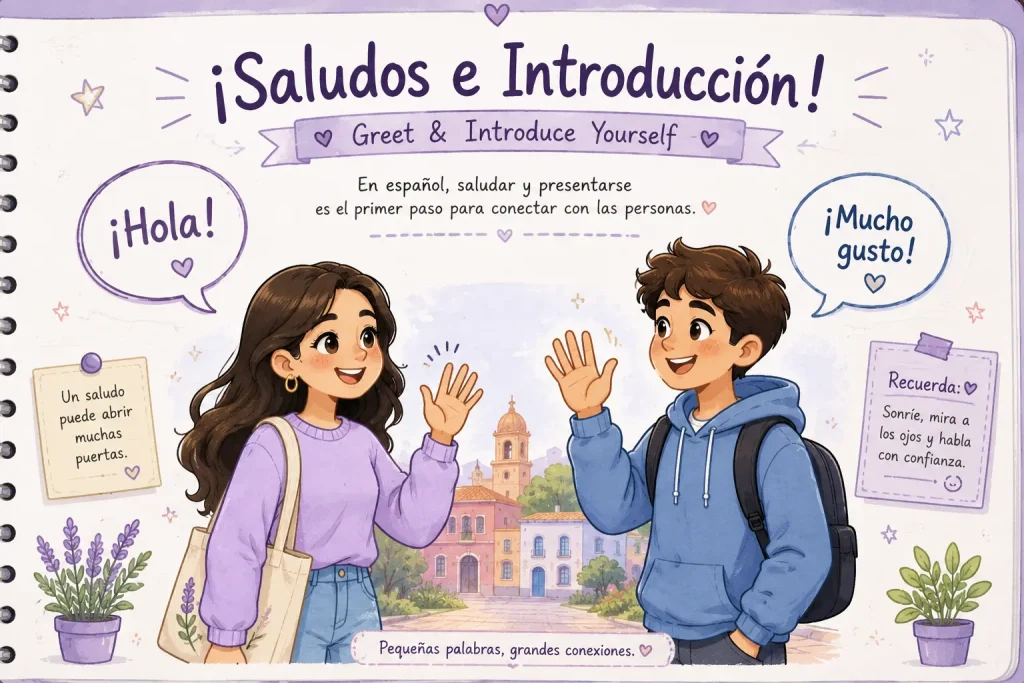
Every friendship starts with a hello and grows through conversation.


