
📚 SPANISH TENSES
Spanish Tenses: The Complete Guide for Beginners
Master Spanish tenses step by step with simple explanations, verb conjugation patterns, practical examples, and exercises designed for beginners.

What Are Spanish Tenses?
Spanish tenses tell us when an action takes place—whether it is happening now, happened in the past, will happen in the future, or expresses possibility, doubt, or desire. Unlike English, Spanish verbs change according to time, subject, and mood, making verb conjugation one of the most important skills for every learner.
In this guide, you’ll explore every major Spanish tense, learn when to use each one, and build a strong foundation for fluent communication.
10+ Spanish Tenses
6 Subject Pronouns
4 Major Tense Categories
100% Beginner Friendly
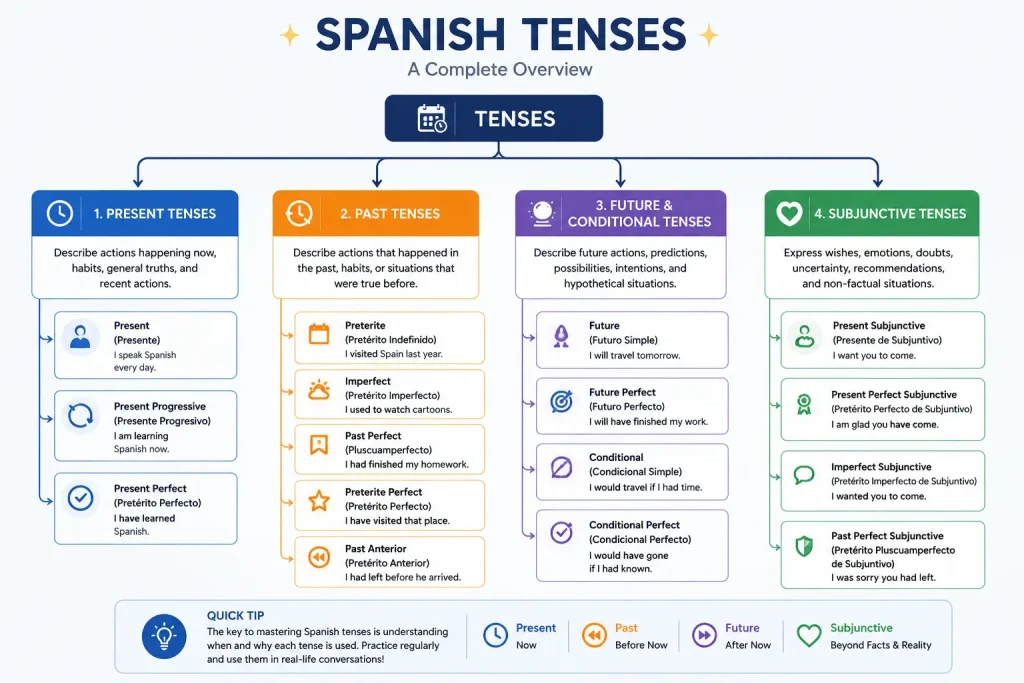
Introduction to Present Tenses
The Present Tenses in Spanish are used to describe actions happening now, daily routines, general facts, ongoing events, and recent actions connected to the present.
The three main present tenses are:
Present Simple (Presente)
The Present Simple (Presente) is used to talk about actions happening now, daily routines, general facts, permanent situations.
Formula:
Subject + Present Verb + Complement
For example-
Mi hermana trabaja desde casa.
My sister works from home..
Siempre llevo una libreta para escribir palabras nuevas.
I always carry a notebook to write new words.
CONJUCATION
| Subject | -AR | -ER | -IR |
|---|---|---|---|
| Yo | -o | -o | -o |
| Tú | -as | -es | -es |
| Él / Ella / Usted | -a | -e | -e |
| Nosotros/as | amos | emos | imos |
| Vosotros/as | -áis | -éis | -ís |
| Ellos / Ellas / Ustedes | -an | -en | -en |
Present Progressive (Presente Progresivo)
The Present Progressive describes actions that are happening right now or are currently in progress.
Formula:
Estar (Present) + Gerund (-ando/-iendo)
For example-
Estoy organizando mi escritorio antes de estudiar.
I am organizing my desk before studying.
Los estudiantes están preparando una presentación.
The students are preparing a presentation.
CONJUCATION
| Infinitive | Gerund Ending | Example |
|---|---|---|
| -AR | -ando | hablar → hablando |
| -ER | -iendo | comer → comiendo |
| -IR | -iendo | vivir → viviendo |
Present Perfect (Pretérito Perfecto)
The Present Perfect is used for actions completed recently or actions that still have a connection to the present.
Formula:
Haber (Present) + Past Participle
For example-
Hoy he aprendido cinco palabras nuevas.
Today I have learned five new words.
Ya hemos reservado los billetes para España.
We have already booked the tickets to Spain.
CONJUCATION
| Subject | Haber |
|---|---|
| Yo | he |
| Tú | has |
| Él / Ella / Usted | ha |
| Nosotros | hemos |
| Vosotros | habéis |
| Ellos / Ellas / Ustedes | han |
| Infinitive | Ending | Example |
|---|---|---|
| -AR | -ado | hablar → hablado |
| -ER | -ido | comer → comido |
| -IR | -ido | vivir → vivido |
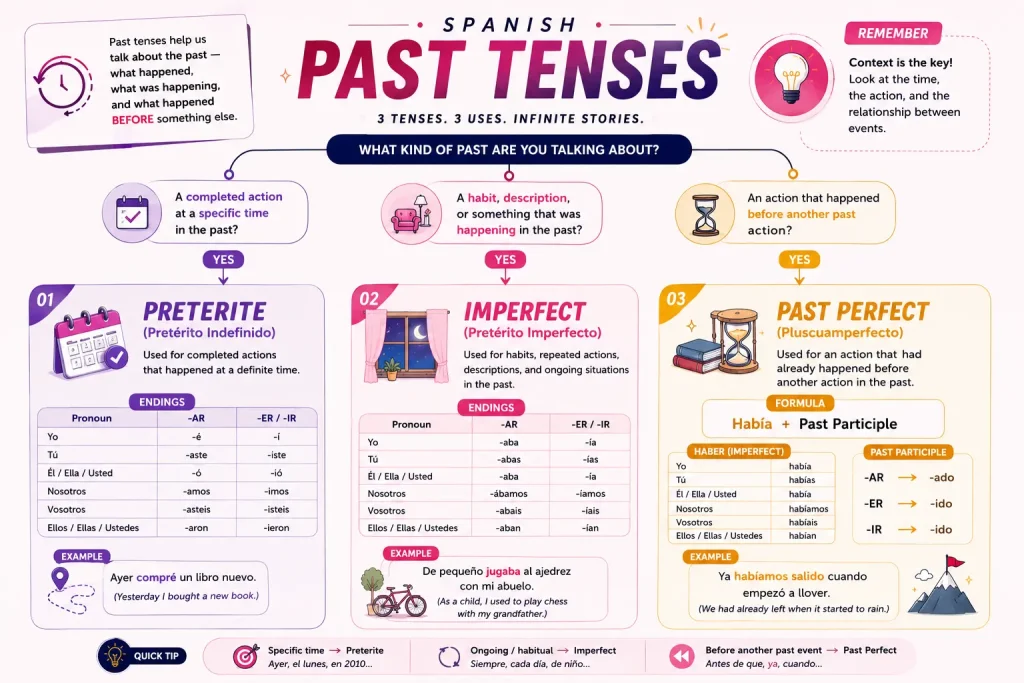
Introduction To Past Tenses
Spanish Past Tenses help you describe completed actions, ongoing situations, and events that happened before another action in the past.
The three essential past tenses are Preterite, Imperfect, and Past Perfect, each serving a different purpose depending on the context.
Introduction To Future And Conditional
The Future & Conditional Tenses allow you to express future plans, predictions, possibilities, and hypothetical situations. These tenses help you communicate with confidence about what will happen, would happen, or will have happened.
Future Simple (Futuro Simple)
The Future Simple is used to express future actions, predictions, promises, and intentions.
Endings (Added to the infinitive)
| Subject | Ending |
|---|---|
| Yo | -é |
| Tú | -ás |
| Él / Ella / Usted | -á |
| Nosotros | -emos |
| Vosotros | -éis |
| Ellos / Ellas / Ustedes | -án |
Formula
Infinitive + Future Ending
Example
- Mañana visitaré el Museo del Prado. (Tomorrow I will visit the Prado Museum.)
Future Perfect (Futuro Perfecto)
Description:
The Future Perfect is used to describe an action that will have been completed before a specific time in the future.
Formula
Haber (Future) + Past Participle
| Subject | Haber |
|---|---|
| Yo | habré |
| Tú | habrás |
| Él / Ella / Usted | habrá |
| Nosotros | habremos |
| Vosotros | habréis |
| Ellos / Ellas / Ustedes | habrán |
Past Participle
- -AR → -ado
- -ER → -ido
- -IR → -ido
Example
- Para las ocho, habré terminado el proyecto. (By eight o’clock, I will have finished the project.)
Conditional Simple (Condicional Simple)
The Conditional Simple is used to express possibilities, polite requests, advice, and hypothetical situations. CONJUCATION
| Subject | Ending |
|---|---|
| Yo | -ía |
| Tú | -ías |
| Él / Ella / Usted | -ía |
| Nosotros | -íamos |
| Vosotros | -íais |
| Ellos / Ellas / Ustedes | -ían |
Formula
Infinitive + Conditional Ending
Example
- Viajaría por India si tuviera más tiempo. (I would travel across India if I had more time.)
Conditional Perfect (Condicional Perfecto)
The Conditional Perfect is used to describe actions that would have happened in the past under different circumstances.
Formula
Haber (Conditional) + Past Participle
| Subject | Haber |
|---|---|
| Yo | habría |
| Tú | habrías |
| Él / Ella / Usted | habría |
| Nosotros | habríamos |
| Vosotros | habríais |
| Ellos / Ellas / Ustedes | habrían |
Past Participle
- -AR → -ado
- -ER → -ido
- -IR → -ido
Example
- Habríamos llegado antes con menos tráfico. (We would have arrived earlier with less traffic.)
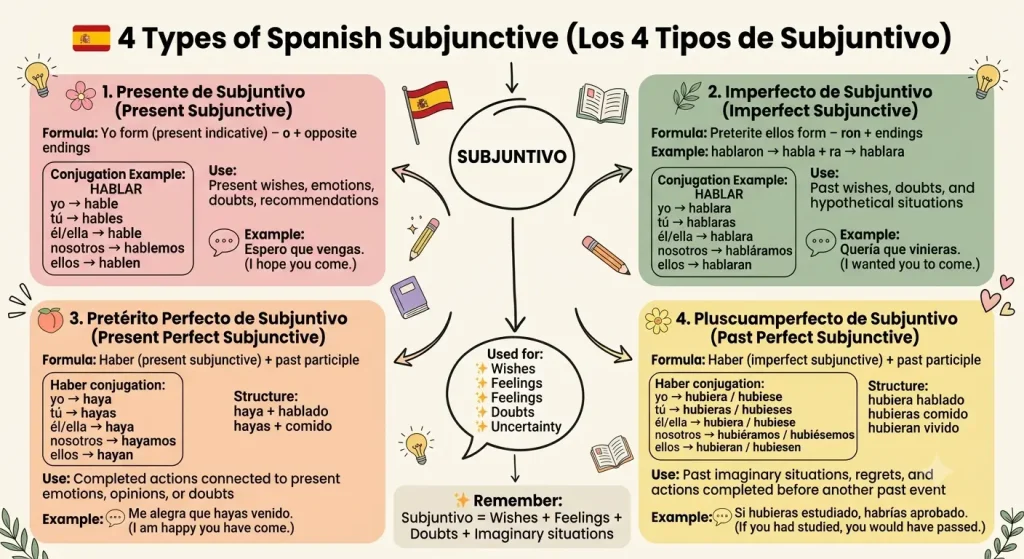
The Subjunctive Mood(El Subjuntivo )
The subjuntivo is a Spanish verb mood used to express wishes, emotions, doubts, recommendations, and uncertain situations. Unlike the indicativo, which talks about facts and reality, the subjuntivo focuses on things that are not confirmed or certain.
Imperatives (El Imperativo)
The imperative mood (el imperativo) is used in Spanish to give commands, orders, instructions, advice, or requests. It tells someone what to do or not do.
Examples:
✅ Habla más despacio.
→ Speak more slowly.
✅ Escucha al profesor.
→ Listen to the teacher.
Types of Imperatives:
Affirmative Imperative (Imperativo Afirmativo)
Used to tell someone to do something.
Example:
Come la comida.
→ Eat the food.
Negative Imperative (Imperativo Negativo)
Used to tell someone not to do something.
Example:
No comas la comida.
→ Don’t eat the food.
Formation:
Tú Affirmative:
Use the third person singular (él/ella) of present indicative.
Hablar → habla
Comer → come
Vivir → vive
Negative Imperative:
No + present subjunctive
No hables
No comas
No vivas
Learning tenses is not only about memorizing conjugations it is about understanding time, context, and meaning. With regular practice, Spanish verbs become natural and easier to use.
Keep practicing, keep speaking, and your Spanish journey will grow step by step


