
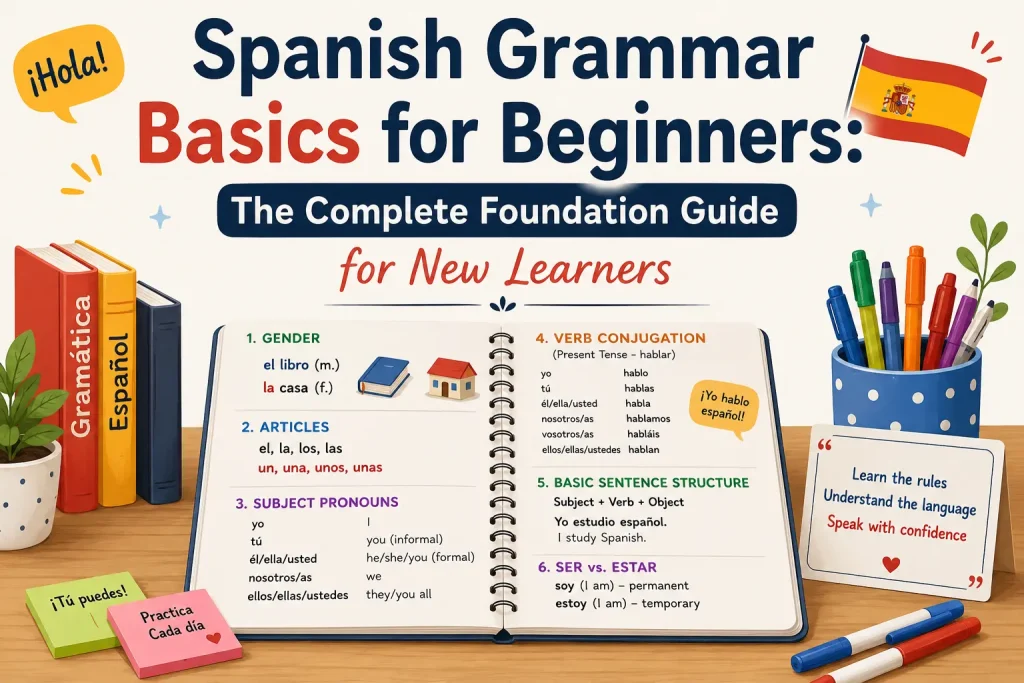
Spanish Grammar Basics for Beginners might not be the first thing that comes to mind when you hear Gasolina, Gata only, Bailando and many other Spanish songs. Many people get curious to learn Spanish after listening to these songs, start to learn simple phrases, and recognize familiar expressions.
Wondering where to begin, check out our Spanish Learning Roadmap for Beginners, where we explain the perfect order to learn Spanish step by step before understanding grammar.
When you start learning Spanish, it seems fun and enjoyable . The real challenge come when you want to create complex sentences and express your thoughts. Sometimes you may have wondered that why does “hablo” mean “I speak” while “hablas” means “you speak”? Why do Spanish words change their endings? This can be explained by the way the language is structured.
That is why Spanish grammar basics for beginners becomes important. Grammar is the foundation that helps in converting individual words into meaningful sentences. In this complete guide, we will explore the Spanish Grammar Basics for Beginners that will help you in having conversations.
For official grammar guidance, you can also explore Instituto Cervantes.
Why Spanish Grammar Basics For Beginners Important To Understand?
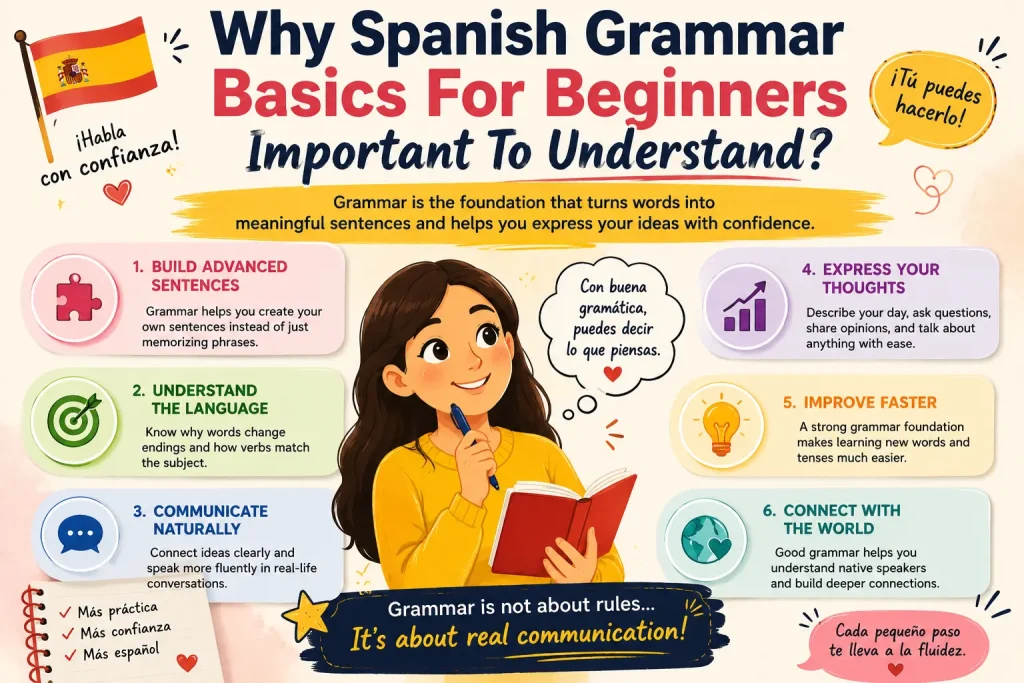
Some beginners thinks that learning Spanish phrases will help them in having conversations. It can be partially true when you just need to have simple conversations. But with time, you need to have advance level conversations where you need to introduce yourself, describe your day, ask questions, or share your opinions that is where understanding Spanish grammar becomes essential.
If you haven’t already, start by learning some Essential Spanish Phrases for Beginners. They help you communicate in everyday situations while you gradually build your grammar skills.
Spanish Grammar helps you in building advance sentences instead of just relying on Spanish phrases that you have learned. It helps you understand why words or some endings change and how ideas are connected naturally.
Learning Spanish Grammar Basics for Beginners is not about memorizing rules. It’s about understanding the basic concepts that help you build sentences and communicate with confidence.
1. Gender In Spanish
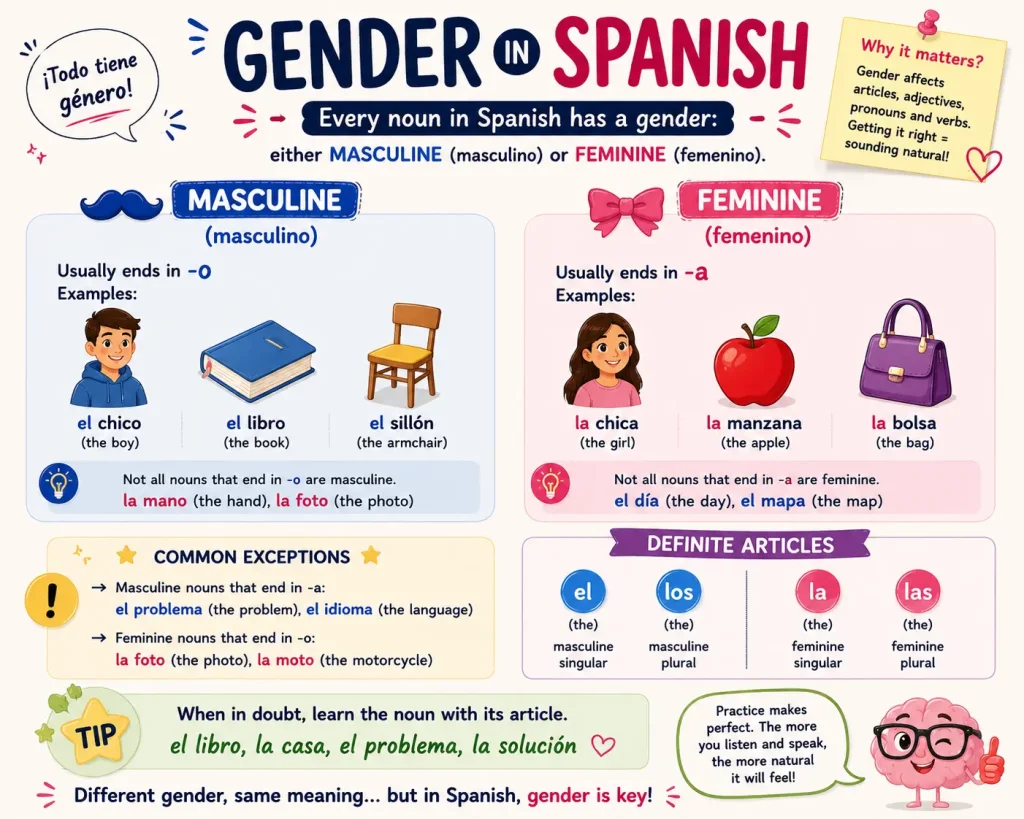
One of the first Spanish grammar basics for beginners is understanding that everything in Spanish have a gender. Unlike English, where most nouns are neutral in gender, Spanish nouns are either masculine or feminine. This gender doesn’t always refer to a person or animal but also to everyday objects, places, and ideas.
Generally nouns ending in -o are masculine, while nouns ending in -a are feminine. For example, el libro (the book) is masculine, and la casa (the house) is feminine. However, there are exceptions, such as el día (the day) and la mano (the hand). Rather than memorizing just nouns try learning them with their articles. This simple technique makes it easy to remember whether a noun is masculine or feminine.
| El libro | La manzana |
| El chico | La chica |
| El perro | La perra |
2. Spanish Articles

Just like English uses definate [the]and indefinate [a,an] articles similarly Spanish also uses them. However, Spanish articles change depending on whether the noun is masculine, feminine, singular, or plural.
Once you understand articles, the next step in Spanish Grammar Basics for Beginners is learning how they work with pronouns and verbs.
Definite Articles (The)
WE use them when we refer to a specific person, place, or thing.
- El – Masculine singular (el café- the coffee)
- La – Feminine singular (la playa– the beach)
- Los – Masculine plural (los museos – the museums)
- Las – Feminine plural (las montañas – the mountains)
We use them when we refer to a non specific or general person, place, or thing.
- Un – Masculine singular (un pasaporte – a passport)
- Una – Feminine singular (una maleta– a suitcase)
- Unos – Masculine plural (unos tacos – some tacos)
- Unas – Feminine plural (unas uvas – some grapes)
Choosing the correct article is an important part of Spanish Grammar Basics for Beginners because it must always agree with the gender and number of the noun.
3. Spanish Subject Pronouns
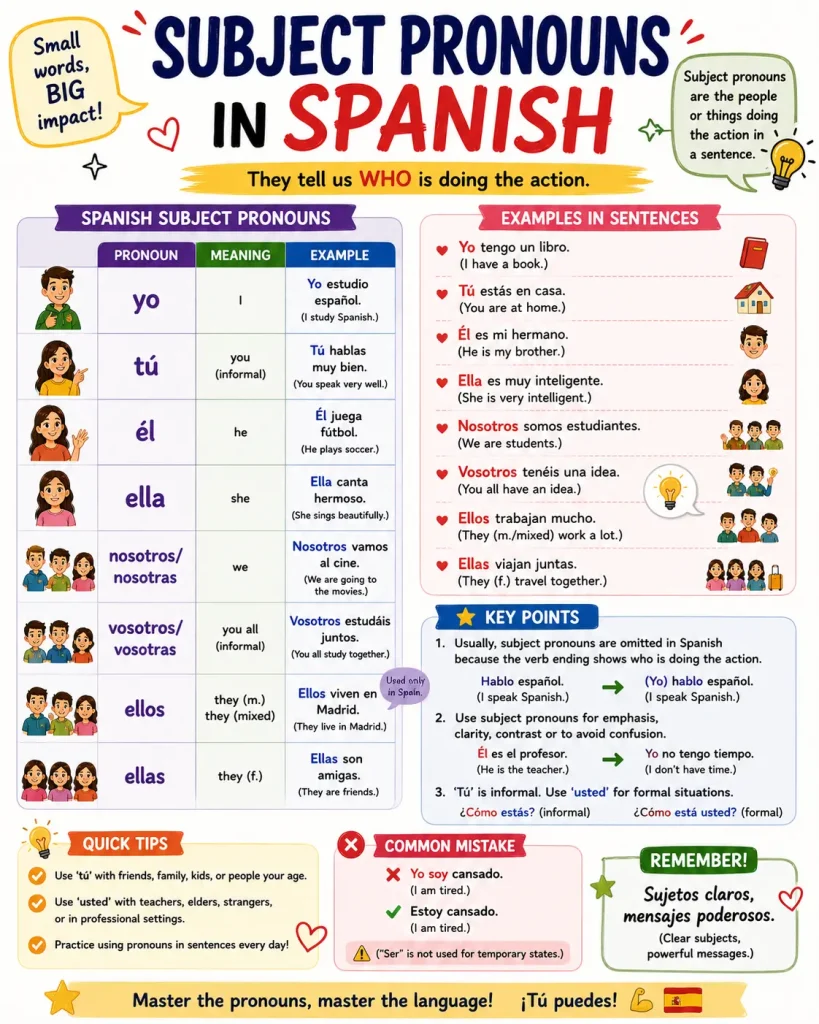
The next step in Spanish Grammar Basics for Beginners is to understand subject pronouns. A subject pronoun tells us who is performing the action in a sentence. Just like English uses pronouns such as I, you, he, and they, Spanish also have similar pronouns.
Here are the most common Spanish subject pronouns:
| Yo | I |
| Tu | You (informal) |
| El | He (singular) |
| Ella | She (singular) |
| Usted | You (formal) |
| Nosotros/as | We all |
| Vosotros/as | You all |
| Ellos | They (masculine plural) |
| Ellas | They (feminine plural) |
| Ustedes | You ( plural) |
4. Spanish Verb Conjugation Basics
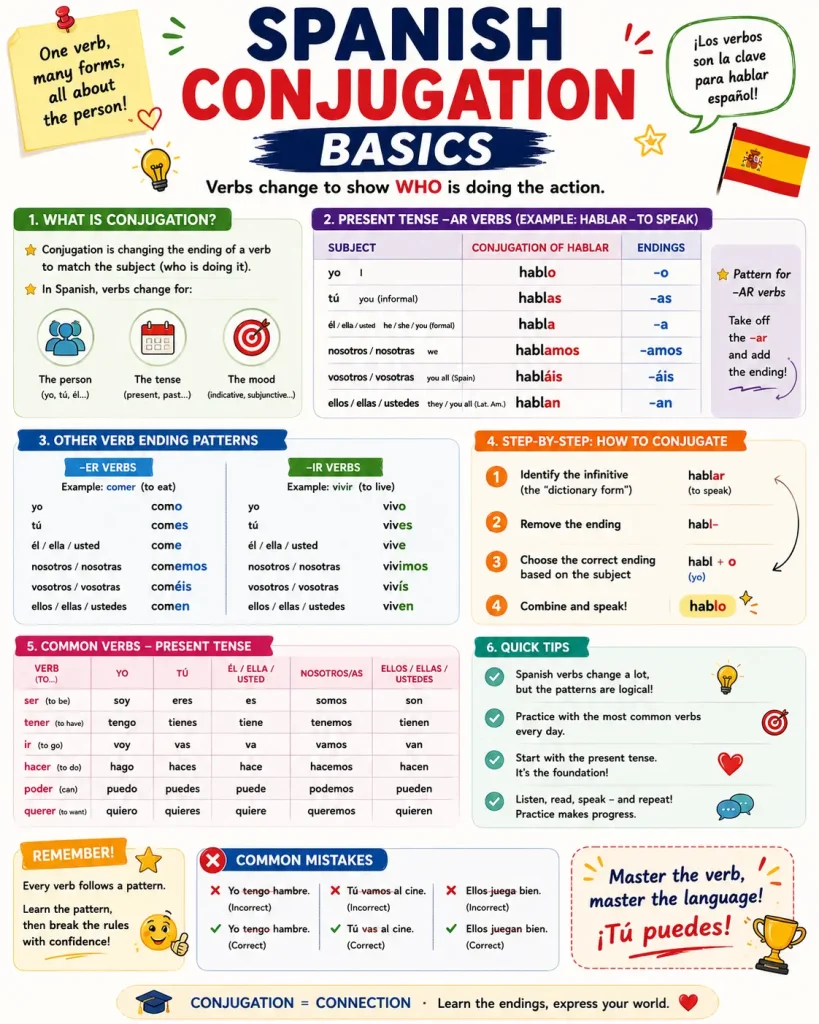
Once we know who is performing the action, the next step is learning what action they are doing. That’s where verb conjugation becomes important to understand. One of the most important Spanish Grammar Basics for Beginners is to understand that Spanish verbs change their endings depending on the subject pronoun.
Verbs in English do not vary much (for example, I speak and he speaks), Spanish verbs have different endings for almost every subject. This helps identify who is performing the action.
Spanish verbs are categorized into 3 groups that have different endings-
- AR verbs (Hablar – To speak)
2 .ER verbs (Comer – To eat)
3. IR verbs (Vivir – To live)
Lets conjugate simple verb hablar which means to speak
| Spanish Subject Pronouns | Conjugation |
| Yo | Hablo |
| Tu | Hables |
| El/Ella/Usted | Hable |
| Nosotros/as | Hablamos |
| Vosotros/as | Hablais |
| Ellos/Ellas/Ustedes | Hablan |
Now that you have learned the core Spanish Grammar Basics for Beginners, it’s time to combine them into meaningful sentences.
5. Basic Sentence Structure

To make sentences using Spanish grammar basics for beginners we need to know that Spanish uses very similar sentence structure that we use in English. The most common sentence pattern in Spanish is:
Subject + Verb + Object
Here are a few examples:
- Yo estudio español. (I study Spanish.)
- Ella bebe café. (She drinks coffee.)
- Nosotros comemos pizza. (We eat pizza.)
First try to make simple sentences. Once you are able to make sentences with basic structure, you can gradually add adjectives, prepositions, questions, and more complex grammar to express your ideas with confidence.
6. Ser vs. Estar: Understanding the Difference
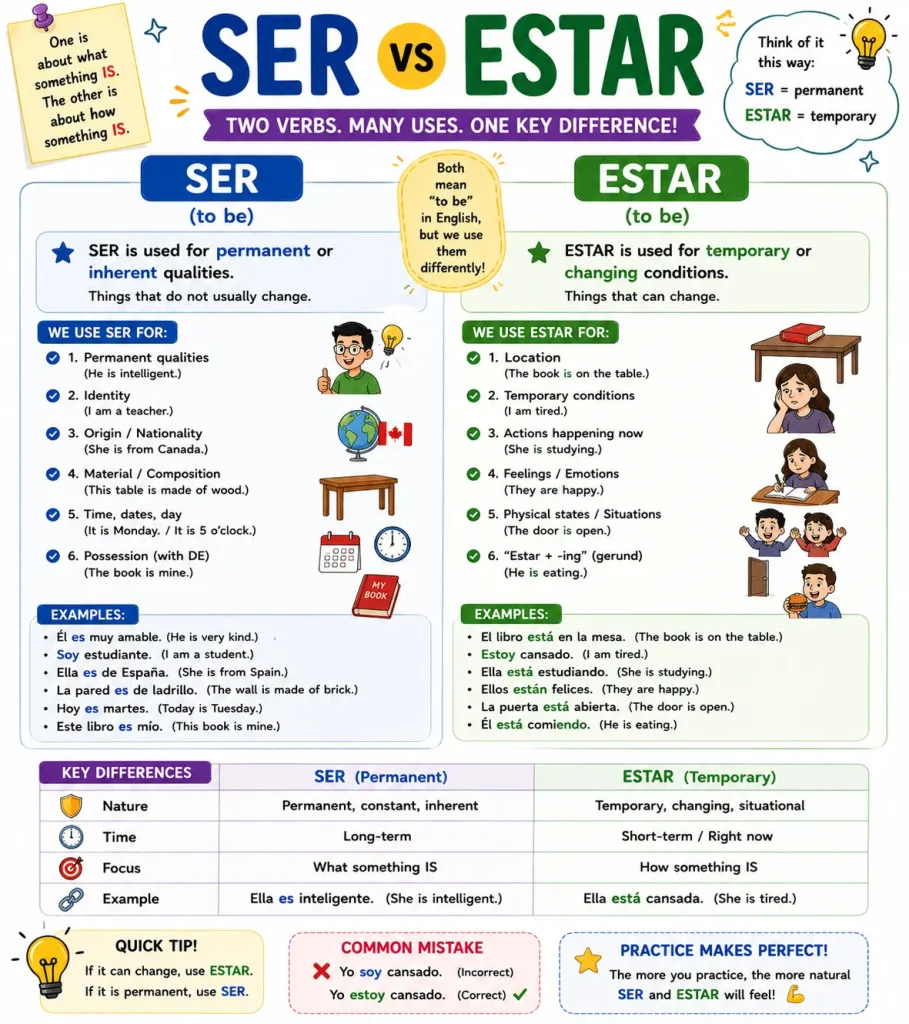
One of the most common challenges in Spanish Grammar Basics for Beginners is understanding the difference between ser and estar. Both verbs mean “to be“ in English, but they are used in different situations.
In simple words, ser is used to describe permanent characteristics, while estar is used for temporary conditions, emotions, or locations.
Use Ser for:
- Identity
- Profession
- Nationality
- Physical characteristics
- Personality traits
- Time and dates
Examples:
- Soy profesor. (I am a teacher.)
- Ella es India. (She is Indian.)
- Hoy es lunes. (Today is Monday.)
Use Estar for:
- Emotions and feelings
- Temporary conditions
- Location
- Ongoing actions (with the gerund)
Examples:
- Estoy cansada.(I am tired.)
- El libro está sobre la mesa. (The book is on the table.)
- Estamos estudiando español. (We are studying Spanish.)
A simple way to remember the difference is to ask yourself whether you are describing something permanent or temporary.
7. Common Spanish Grammar Mistakes Beginners Should Avoid
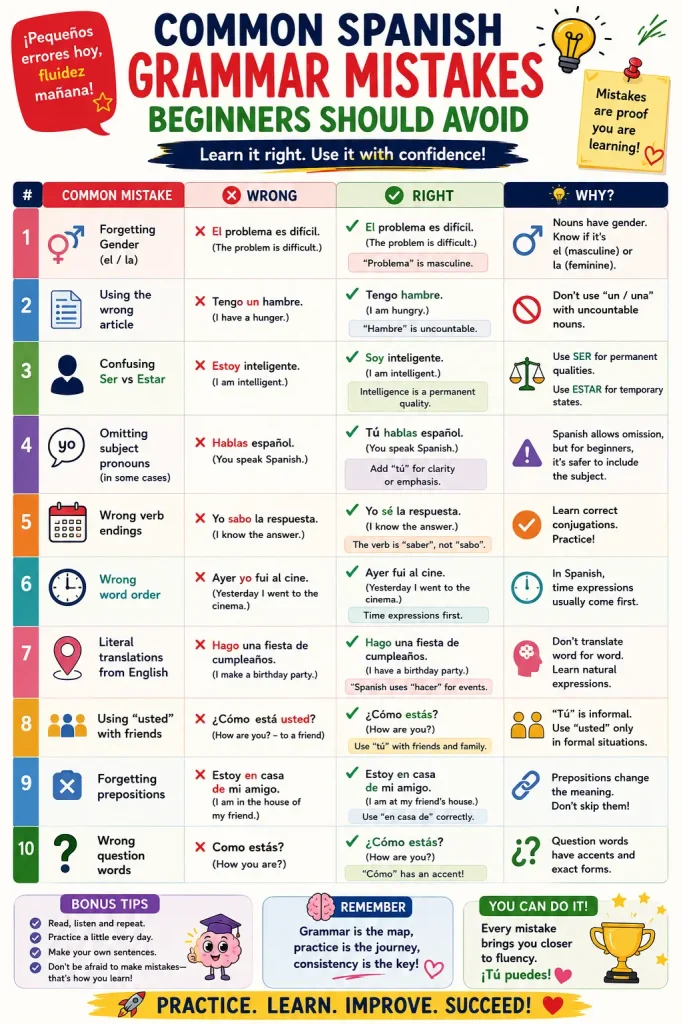
Learning often leads to many mistakes and while learning Spanish people make many mistakes. As you continue learning Spanish Grammar Basics for Beginners, being aware of common errors can help you avoid confusion and build confidence more quickly.
Here are some of the most common grammar mistakes beginners make:
1. To forget Conjugating Verbs
A common mistake is using the infinitive form instead of the correct verb ending. For example, instead of saying “Yo hablar español,” the correct sentence is “Yo hablo español.”
2. Getting Confuse Between Ser and Estar
Since both verbs mean “to be,” it’s easy to get confuse. Remember that ser is generally used for permanent characteristics, while estar is used for temporary conditions, emotions, and locations.
3. Translating Directly from English
Spanish does not follow English grammar rules, it have its own rules and grammatical structure. Instead of translating word to word, focus on learning Spanish sentence patterns and expressions naturally.
Frequently Askes Questions
These are some of the most common questions learners ask about Spanish Grammar Basics for Beginners.
1. Can I speak Spanish without learning grammar first?
Yes, you can learn a few phrases and have basic conversations without studying grammar in deep. But grammar is important when you want to make complex sentences and express ideas clearly.
2. Why do Spanish words change their endings?
One of the unique features of Spanish is that words change their endings to show information such as gender, number, or who is performing an action.
3. Should I memorize grammar rules or learn them through practice?
Understanding the rule is important, but using them in real life helps you to learn them. Instead of memorizing long grammar explanations, try using each new concept in your own sentences.
4. At what point should I start learning Spanish tenses?
Once you master the grammar basics such as gender, articles, pronouns, sentence structure, and the present tense then, you can gradually begin learning other tenses.
Conclusion
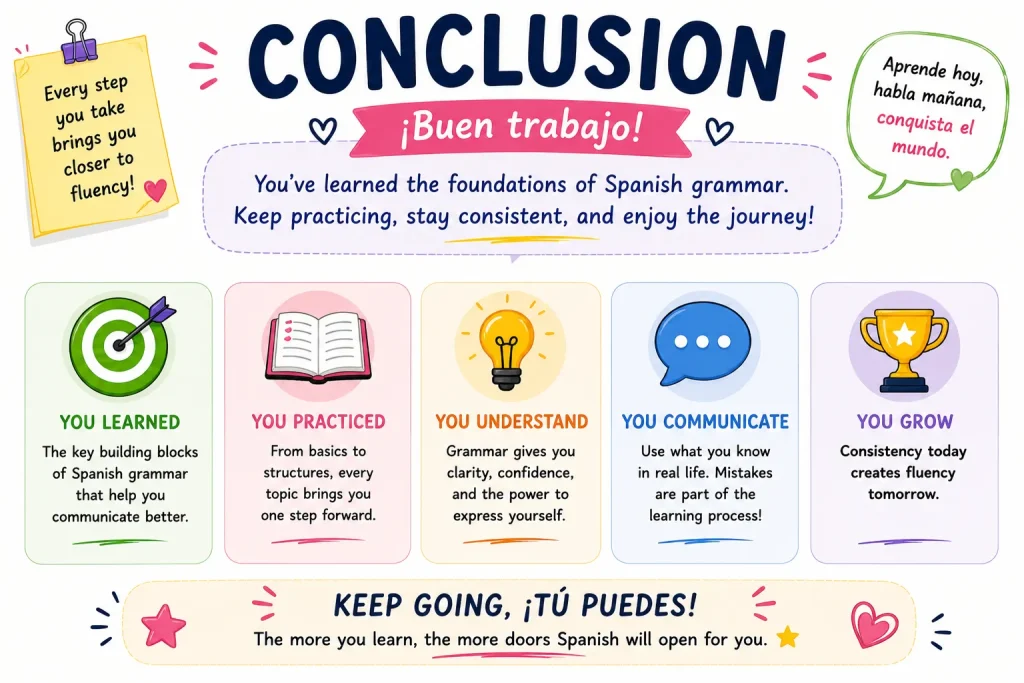
By understanding the Spanish Grammar Basics for Beginners, you have taken the first step toward forming sentences, expressing your ideas with confidence, and communicating more naturally in Spanish. Focus on one concept at a time, practice consistently and build your own sentences.
This grammar guide will help in your basics of Spanish grammar. As you continue your journey of learning Spanish remember that every sentence you write, every conversation you practice, and every mistake you correct helps you become a more confident Spanish speaker.
¡Mucho éxito en tu viaje de aprendizaje del español! (Wishing you great success on your Spanish learning journey!)


2 Responses