
Spanish listening practice sounds simple until you actually try to understand a native Spanish speaker.
You know the vocabulary. You have studied grammar. You can read a Spanish sentence and understand exactly what it means. If you’re still building your Spanish foundation, go read our guide on Spanish grammar before diving deeper into listening practice.
Then someone says the same sentence out loud, and suddenly you are thinking, “Wait… what did they just say?” When a native speaker says it naturally, it can feel like the words have been fixed together and spoken at double speed.
But it is natural to happen because you are not trained to understand Spanish in at it’s natural speed yet. You just need to start listening to natives. And just like you trained yourself to recognize Spanish words on a page, you can train yourself to recognize those same words when you hear them.
In this guide, we willl learn why spoken Spanish feels so difficult to understand, how to practice listening as a beginner, what to listen to, whether you should use subtitles, and how to build a simple daily routine that actually works.
So, let’s turn that “¿Qué did they just say?” feeling into “Ohhh, I understood that”
Why Is Spanish Listening Practice So Difficult for Beginners?
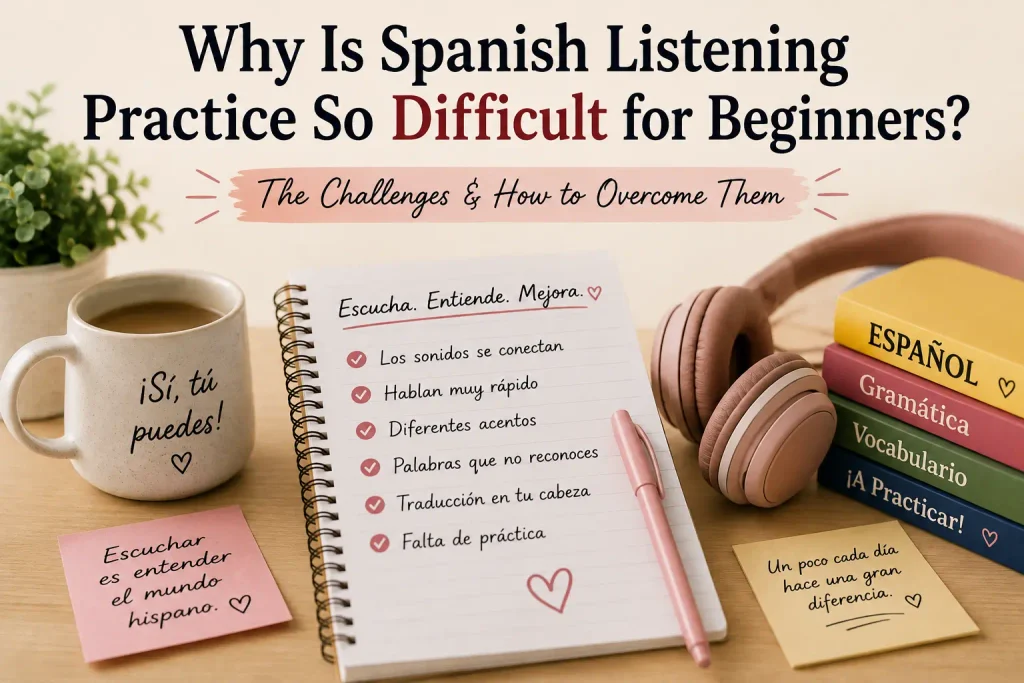
Spanish listening practice can feel difficult at start, even when you already know little Spanish. You may understand Spanish grammar, recognize common vocabulary, and read simple sentences without much trouble. But when a native speaker starts talking, you don’t understand a single word. Have you ever wondered why?
1. Spoken Spanish Doesn’t Have Spaces Between Words
When you read Spanish, every word has space between them so you can clearly read and understand them. For example- ¿Qué estás haciendo?
However, during a real conversation words flow into one another. There are no spaces between the words that can stop and say “Here’s the next word!”This is one reason Spanish listening can be much harder than reading comprehension for beginners.
The more Spanish listening practice you do, the better your brain becomes at identifying where one word ends and another begins.
2. Native Speakers Don’t Speak Like Textbooks
Textbooks are designed to help you learn, so the Spanish used in beginner lessons is often slower, clearer, and more carefully pronounced. But the real conversations that people do are different.
Native speakers naturally speak at their normal pace. They may shorten sounds, connect words, repeat themselves, change their tone, or leave out parts of a sentence that are obvious from context. The sounds may flow together so quickly that the learner struggles to identify the individual words.
This does not necessarily mean the speaker is speaking too fast. They are simply speaking naturally like you do in your native language.
That is why listening to authentic Spanish is important. Your goal is not to make every native speaker slow down. Your goal is to train your brain to understand Spanish at its natural speed.
3. You Know the Word, But Can’t Recognize It
Sometimes you know a Spanish word perfectly when you see it written, but you don’t recognize it when someone says it. This happens because your brain has learned the written form of the word but has not yet connected it strongly to its sound. Regular listening helps build that connection.
4. Different Spanish Accents
Spanish is spoken in many countries, and each region has its own accent and pronunciation. Spanish from Spain can sound different from Spanish spoken in Mexico, Argentina, Colombia, or other Latin American countries.
At first, these differences can be confusing, but listening to different accents gradually makes your understanding more flexible.
Want to explore the differences between Spanish-speaking regions? Go read our guide to Spanish varieties and discover how Spanish changes across different countries.
5. You Try to Understand Every Word
Beginners often try to translate every word while listening into their native language. This can make you fall behind because native speakers don’t pause while you translate.
Instead, focus on understanding the main idea first. With practice, you will gradually understand more words without consciously translating each one.
How to Improve Your Spanish Listening Skills
Improving your Spanish listening practice does not require spending hours watching Spanish movies or listening to difficult podcasts or songs. Listening regularly with the right technique will help you understand spanish and listening effectively.
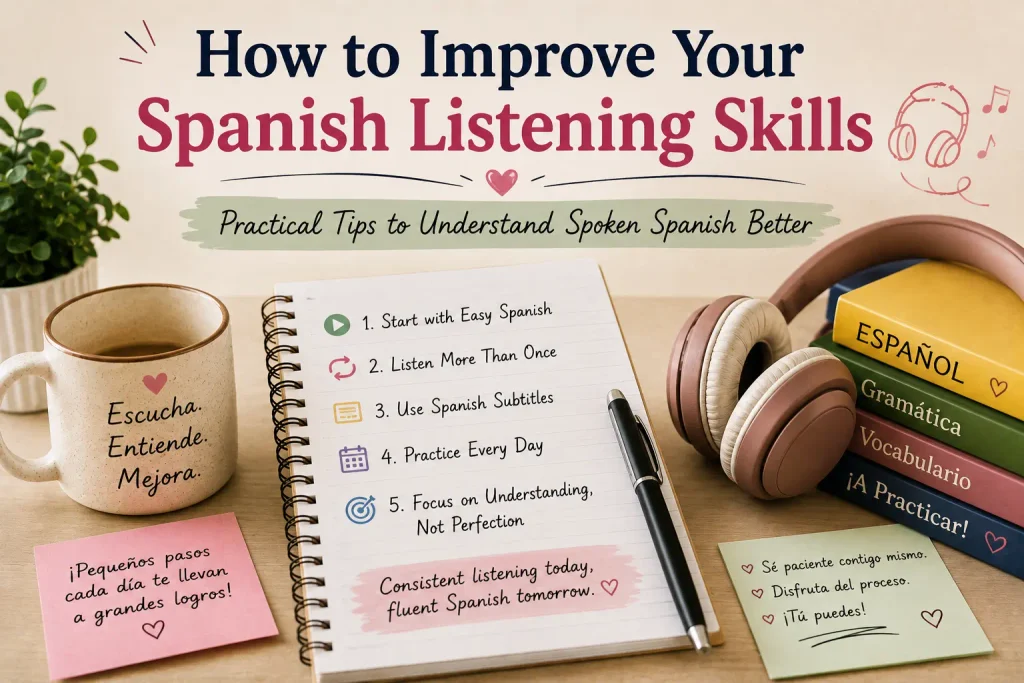
1. Start With Easy Spanish
When you begin to do Spanish listening practice, don’t immediately choose fast movies, complicated and difficult podcasts. Start with basic Spanish that you can understand. Beginner podcasts, slow Spanish videos, and short conversations are great options.
For extra listening practice, you can also explore the free Spanish-learning resources from the Instituto Cervantes, including podcasts and listening activities.
As your listening improves, you can gradually move to faster, more natural Spanish.
2. Listen More Than Once
Repetition is an important part of effective Spanish listening practice. Don’t listen to something only once and move on. Listening to the same audio again helps your brain recognize words and phrases you missed the first time.
Try listening once for the main idea, then listen again and focus on the words you couldn’t catch.
3. Use Spanish Subtitles
Spanish subtitles can make Spanish listening practice much easier. They help you connect the sounds you hear with the words you already know.
Try listening without subtitles first. Then turn on Spanish subtitles and check what you missed. Finally, listen again without subtitles and see how much more you understand.
4. Practice Every Day
The key to successful Spanish listening practice is consistency. You don’t need to spend two hours listening every day. Even 15–20 minutes of Spanish listening practice can make a difference when you do it consistently. You can listen to beginners podcast while getting ready for your day or while travelling.
The goal is to make listening to Spanish a regular part of your day.
5. Don’t Try to Understand Every Word
One of the biggest mistakes beginners make during Spanish listening practice is trying to understand every single word.
Instead, focus on the overall meaning of what you are hearing. It’s completely normal to miss some words, especially when listening to native speakers. With regular practice, your brain will gradually become better at recognizing unfamiliar words and expressions.
How to Use Subtitles for Spanish Listening Practice
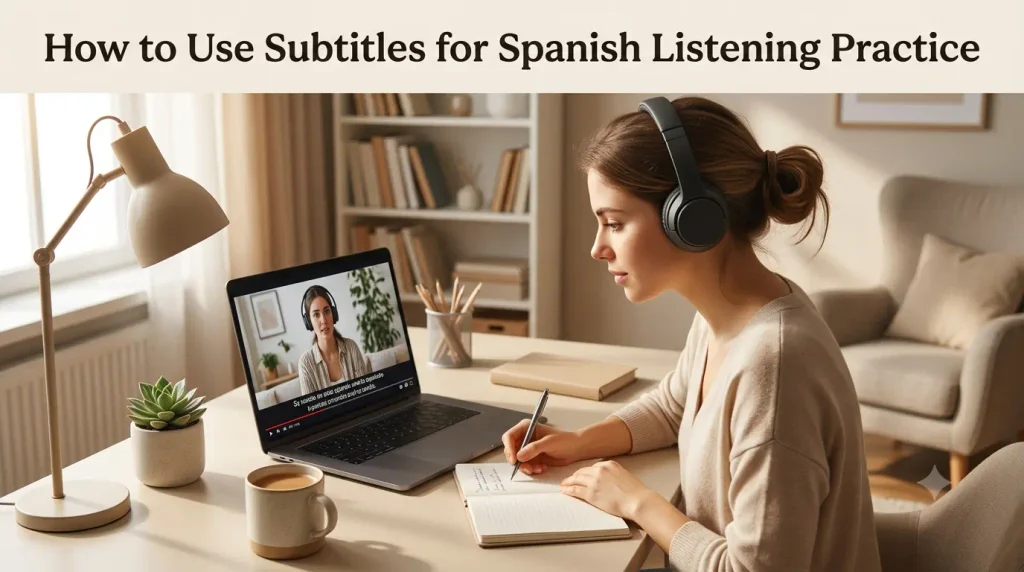
Subtitles can be really helpful during Spanish listening practice, but using them incorrectly can make you depend on reading instead of listening.
Start by listening to a short video or audio clip without subtitles. Try to understand the main idea and notice how many words you recognize. Don’t worry if you miss several words.
Next, turn on Spanish subtitles and listen again. Pay attention to the words you heard incorrectly or didn’t recognize. Seeing the written form can help you connect the sound with the word.
Finally, turn the subtitles off and listen one more time. You may be surprised by how much easier the same audio sounds.
Try to avoid using subtitles in your native language whenever possible. They can make you focus on reading the translation instead of training your Spanish listening skills.
A Simple Daily Spanish Listening Practice Routine
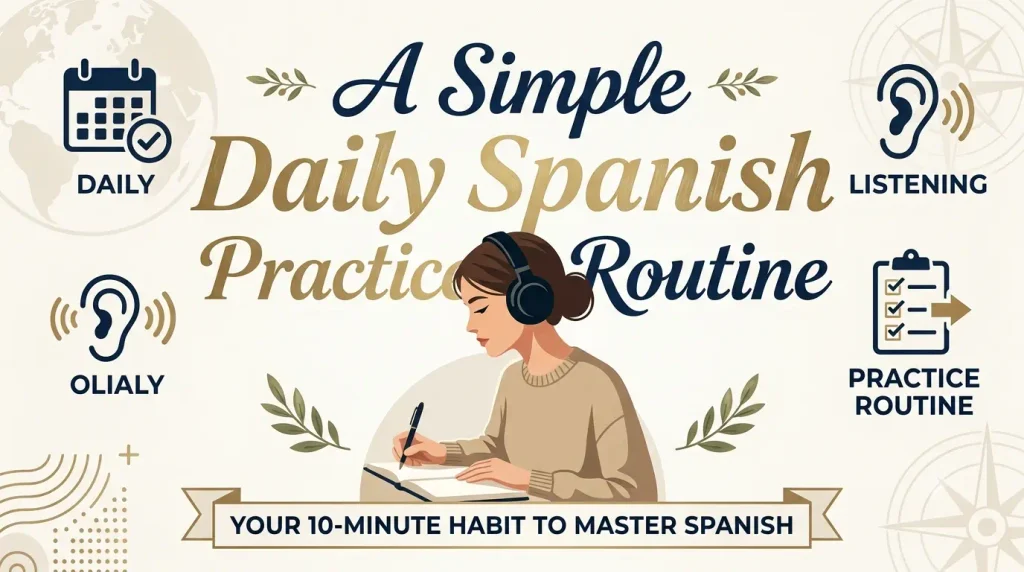
You don’t need to spend hours every day to improve your listening. A short and consistent routine can be much more effective.
Try this 20-minute Spanish listening practice routine:
5 minutes: Listen to a short Spanish video or audio without subtitles. Focus only on the general meaning.
5 minutes: Listen again with Spanish subtitles. Check the words and phrases you missed.
5 minutes: Listen without subtitles again. Try to understand the same content more easily.
5 minutes: Repeat a few sentences aloud. This helps you become more familiar with Spanish pronunciation, rhythm, and natural speech.
The most important part is consistency. 20 minutes of Spanish listening practice every day is better than listening for two hours once a week.
Common Mistakes to Avoid
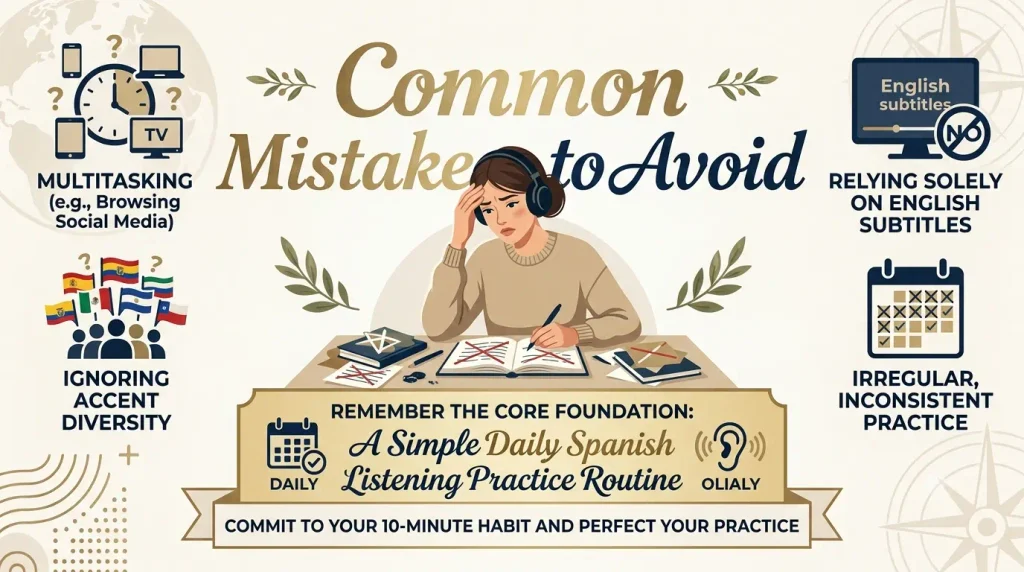
When starting Spanish listening practice, it’s easy to make a few mistakes.
Listening to content that is too difficult: If you understand almost nothing, choose easier and beginners friendly material. Your brain needs understandable Spanish to build confidence.
Stopping after every unknown word: You don’t need to understand everything. Keep listening and try to understand the context. You can create a list of words that you do not know and towards the end of video you can search them all at once.
Using subtitles all the time: Subtitles are useful, but gradually challenge yourself to listen without them.
Practicing only occasionally: Listening improves through regular exposure. Make Spanish part of your daily routine even for 10 minutes can make huge difference.
Conclusion
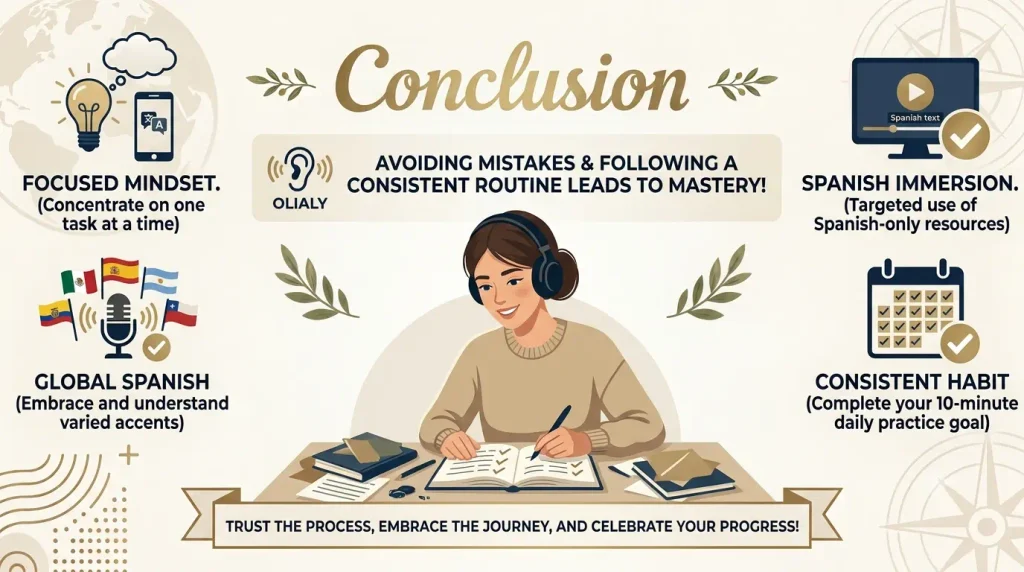
Spanish listening practice may feel difficult at first, but that doesn’t mean you’re bad at Spanish. Your ears simply need time to become familiar with natural Spanish.
Start with content you can mostly understand, listen regularly, use Spanish subtitles strategically, and gradually challenge yourself with faster and more natural conversations.
You don’t need to understand everything on day one. Every conversation you listen to is training your brain to recognize Spanish more naturally.
Keep listening, keep practicing, and eventually that frustrating “¿Qué dijeron?” moment will start becoming “¡Ah, entendí!”.


