
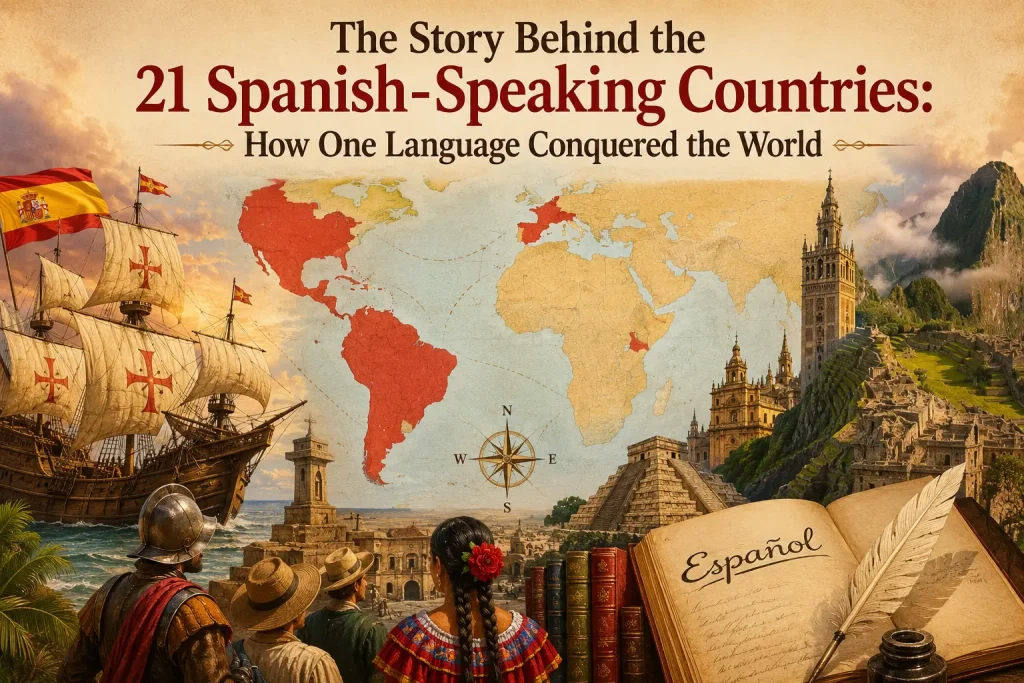
Imagine you are on a tour to Latin-American countries, going to Barcelona, your next stop is Costa Rica then traveling to Colombia, Argentina, and Peru without learning a new language at every stop. Sounds incredible, doesn’t it?
But for sure the question how is this even possible might have strike your mind. How can countries separated by thousands of miles, diverse cultures, and unique histories all share the same language?
The answer lies in one of history’s most fascinating stories of exploration, colonization, and cultural exchange. Over centuries, Spanish spread far beyond the borders of Spain, becoming the official language of 21 Spanish-speaking countries and one of the most widely spoken languages in the world.
In this guide, you’ll discover why Spanish is spoken in so many countries, explore the 21 Spanish-speaking countries, and uncover the remarkable journey that transformed Spanish into a truly global language.
Spanish: The World’s Second Most Spoken Native Language
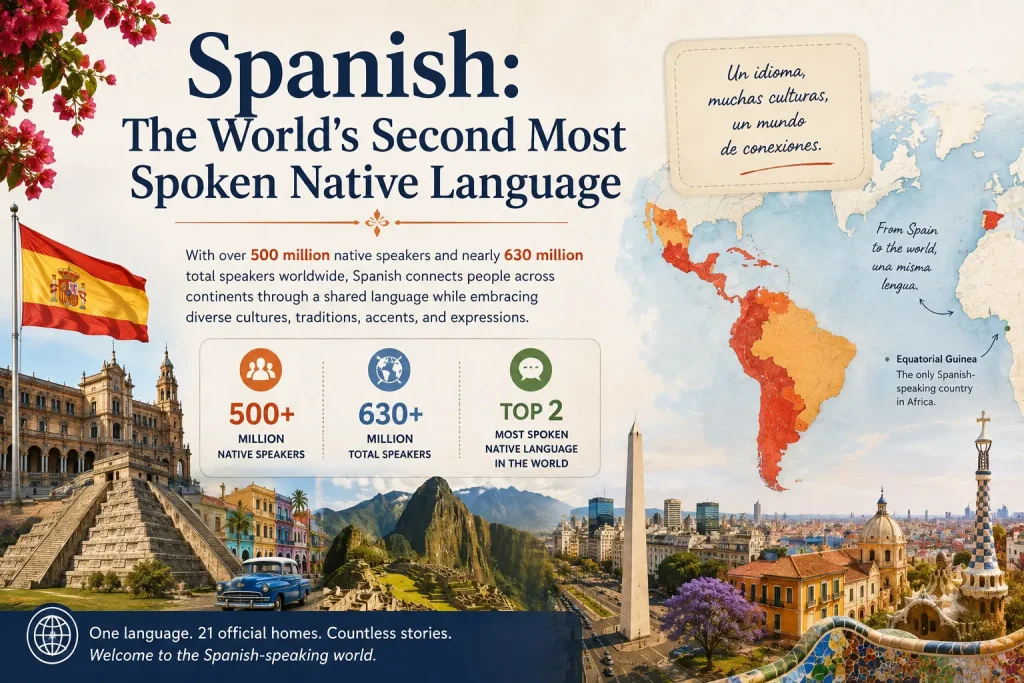
When you think of the Spanish-speaking countries, you often think about Spain or Mexico. But the Spanish-speaking world is far bigger than most people realize. Today, it is the official language of 21 Spanish-speaking countries, across Europe, North America, South America, the Caribbean, and Africa. This remarkable global presence makes Spanish one of the most widely spoken and influential languages in the world.
With over 500 million native speakers and nearly 630 million total speakers worldwide, Spanish has become one of the most influential global languages. Beyond its impressive numbers, it connects people through a shared language while embracing diverse cultures, traditions, accents, and local expressions.
Whether you want to learn Spanish, explore Latin American countries, want to study abroad, or simply explore the Hispanic world, understanding where Spanish is spoken and exploring the Spanish-speaking countries helps you appreciate how and why Spanish has become a global language.
From Europe to Latin America: Where Is Spanish Speaking Countries?
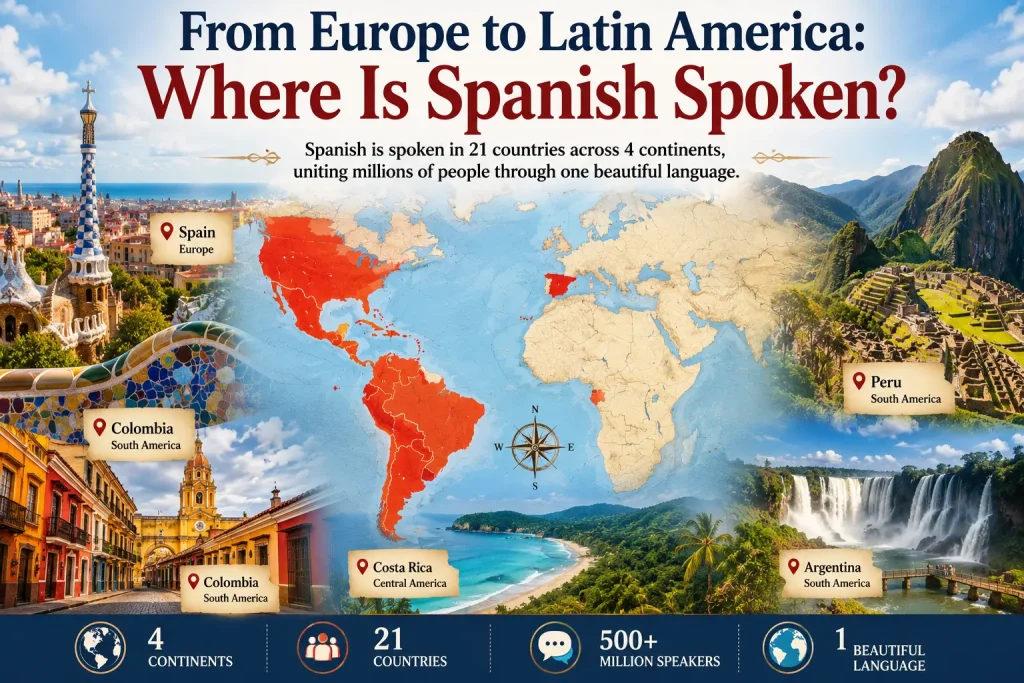
The Spanish-speaking countries are spread over four continents, making Spanish one of the world’s most widespread and influential languages. While, Spain is where Spanish started but now spoken beyond Europe. Most Spanish-speaking countries are located in Latin America, stretching from Mexico in North America to Argentina and Chile in South America.
Spanish is also an official language in the Caribbean and Equatorial Guinea in Africa, which clearly shows how it is extended beyond a single region. Despite the distance between these nations, they share a common language while celebrating their own unique cultures, traditions, accents, and local expressions. This incredible diversity is what makes exploring the Spanish-speaking world such a fascinating experience.
Meet the 21 Spanish-Speaking Countries
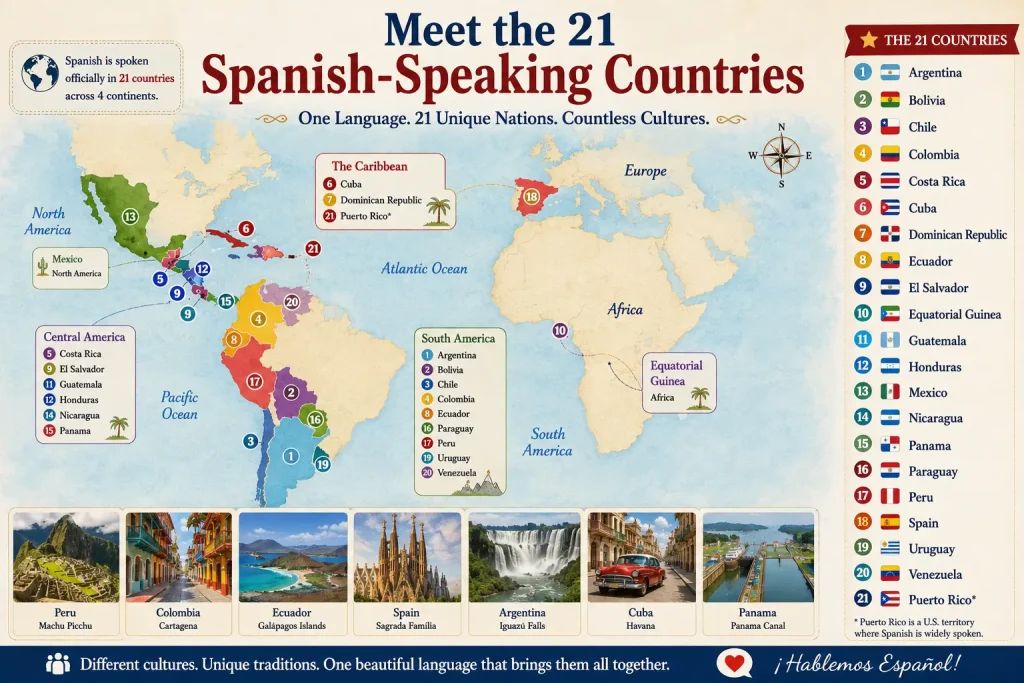
Now that you know why Spanish is spoken across the world, let’s explore the Spanish-speaking countries that make up this diverse global community. From the vibrant streets of Mexico City and the architectural wonders of Barcelona to the breathtaking landscapes of Peru, Chile, and Argentina. Every country has its own unique identity, culture, beliefs and dialects.
Whether you are learning Spanish, planning your next adventure, or simply exploring the Spanish-speaking world, getting to know these countries is the perfect place to start.
| 🌍 Country | 🏛 Capital | ✨ Fun Fact |
|---|---|---|
| Argentina | Buenos Aires | Birthplace of the tango. |
| Bolivia | Sucre | Home to the world’s largest salt flat, Salar de Uyuni. |
| Chile | Santiago | Home to the driest desert on Earth. |
| Colombia | Bogotá | World-famous for its coffee. |
| Costa Rica | San José | Nearly 30% of the country is protected nature. |
| Cuba | Havana | Famous for its colorful vintage cars. |
| Dominican Republic | Santo Domingo | Home to the oldest European city in the Americas. |
| Ecuador | Quito | Gateway to the Galápagos Islands. |
| Equatorial Guinea | Malabo | The only Spanish-speaking country in Africa. |
| El Salvador | San Salvador | Known as the “Land of Volcanoes.” |
| Guatemala | Guatemala City | Home to the ancient Mayan city of Tikal. |
| Honduras | Tegucigalpa | Part of the world’s second-largest coral reef. |
| Mexico | Mexico City | Has the world’s largest native Spanish-speaking population. |
| Nicaragua | Managua | Known as the “Land of Lakes and Volcanoes.” |
| Panama | Panama City | Home to the world-famous Panama Canal. |
| Paraguay | Asunción | Most people speak both Spanish and Guaraní. |
| Peru | Lima | Home to Machu Picchu one of the world’s most famous archaeological sites and a UNESCO World Heritage Site |
| Spain | Madrid | Birthplace of the Spanish language. |
| Uruguay | Montevideo | Won the first-ever FIFA World Cup. |
| Venezuela | Caracas | Home to Angel Falls, the world’s tallest waterfall. |
| Puerto Rico* | San Juan | Famous for salsa, reggaeton, and beautiful beaches.v |
Together, these 21 Spanish-speaking countries represent a remarkable mix of cultures, landscapes, traditions, and accents while remaining connected through one shared language.
Which Country Has the Most Spanish Speakers?
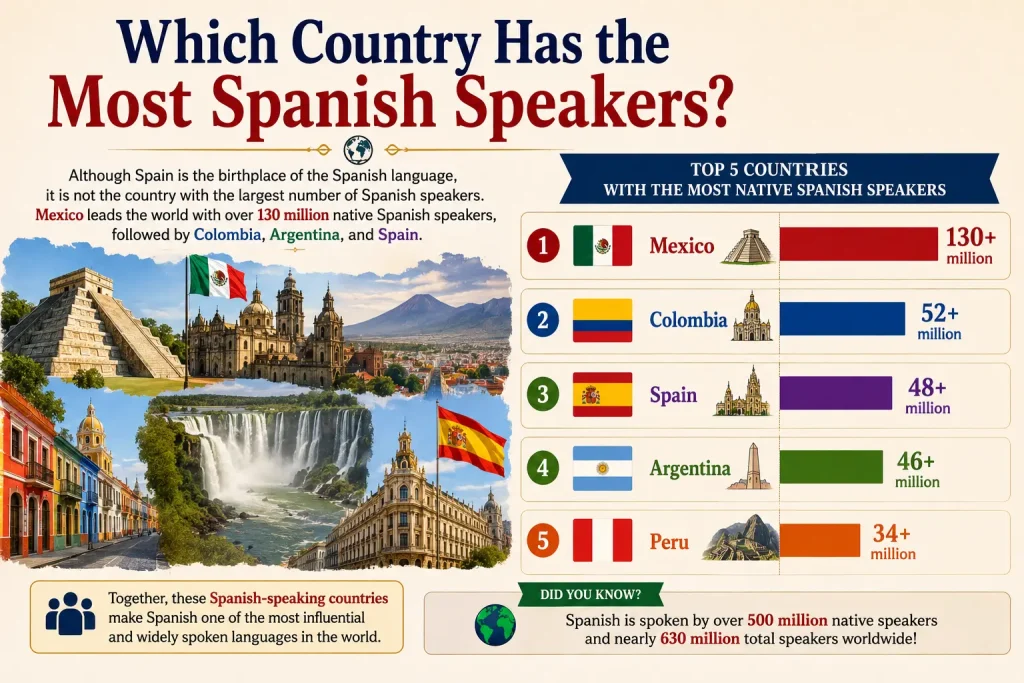
Although Spain is the birthplace of the Spanish language, but it is not the country with the largest number of Spanish speakers. It is Mexico with more than 130 million people, making it the largest Spanish-speaking country. Colombia, Argentina, and Spain also have large Spanish-speaking populations, each contributing to the language’s rich diversity. Together, these Spanish-speaking countries make Spanish one of the most influential and widely spoken languages in the world.
Top 5 Countries with the Most Native Spanish Speakers
| Rank | Country | Native Spanish Speakers (Approx.) |
|---|---|---|
| 🥇 | Mexico | 130+ million |
| 🥈 | Colombia | 52+ million |
| 🥉 | Spain | 48+ million |
| 4️⃣ | Argentina | 46+ million |
| 5️⃣ | Peru | 34+ million |
Is Spanish the Same in Every Spanish-Speaking Country?
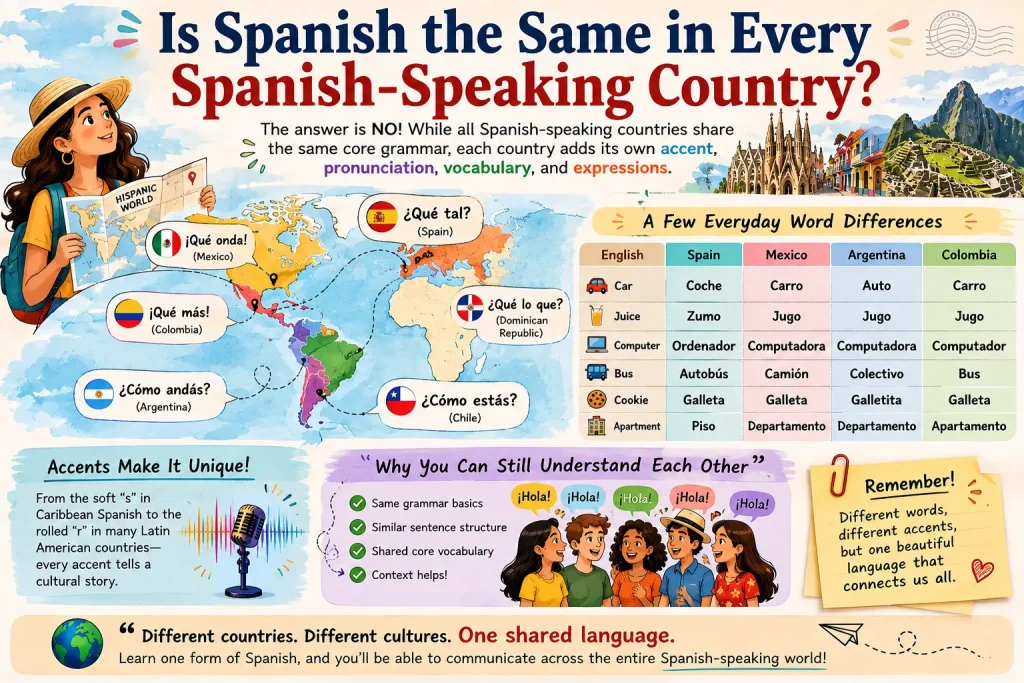
The Spanish-speaking countries share the same core grammar. However, each country has developed its own accent, pronunciation, vocabulary, and everyday expressions over time. Just as there are many dialects as well as accent of English language and it is all different in the UK, the US, and Australia.
Spanish also has regional variations that reflect each country’s culture and identity. If you are able to learn of one country, you will still be able to communicate confidently across the entire Spanish-speaking world. Because it mostly differs in accents and pronunciation.
A Few Everyday Word Differences
| English | Spain | Mexico | Argentina |
|---|---|---|---|
| Car | Coche | Carro | Auto |
| Juice | Zumo | Jugo | Jugo |
| Computer | Ordenador | Computadora | Computadora |
| Bus | Autobús | Camión | Colectivo |
Fascinating Facts About the Spanish-Speaking World
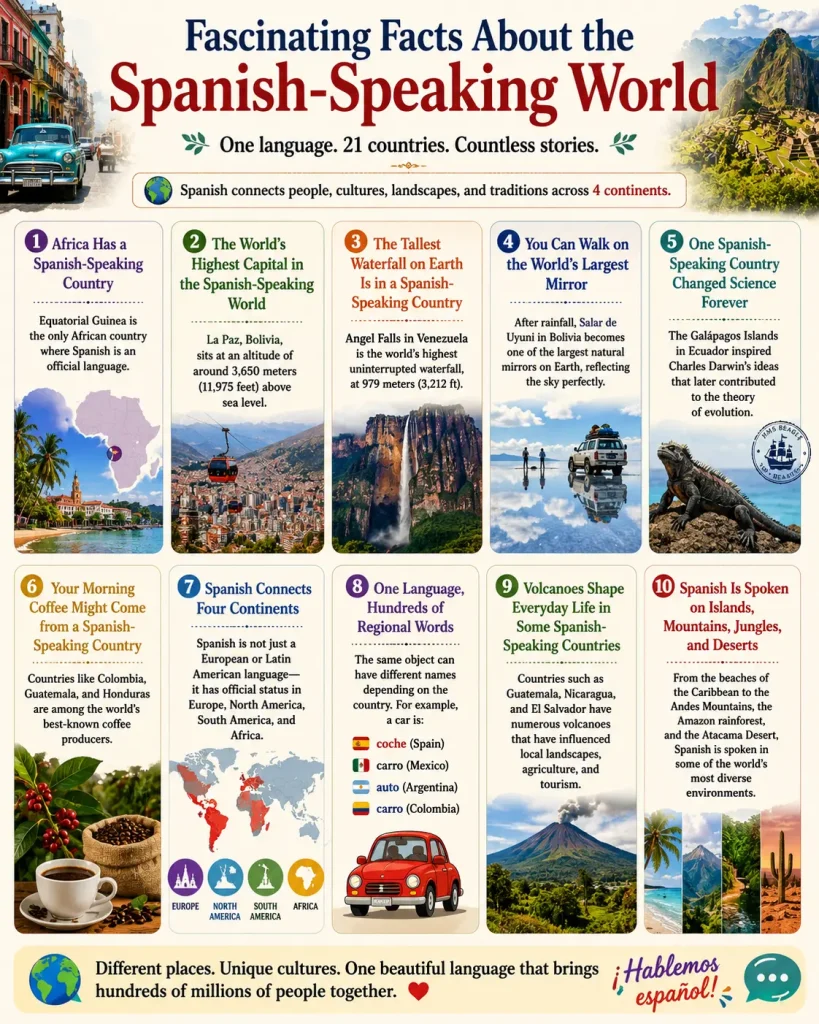
1. Africa Has a Spanish-Speaking Country
Equatorial Guinea is the only African country where Spanish is an official language.
2. The World’s Highest Capital in the Spanish-Speaking World
La Paz, Bolivia, has an altitude of around 3,650 meters (11,975 feet) above sea level.
3. The Tallest Waterfall on Earth Is In Spanis- speaking country
Angel Falls in Venezuela is the world’s highest uninterrupted waterfall.
4. You Can Walk on the World’s Largest Mirror
After rainfall, Salar de Uyuni in Bolivia becomes one of the largest natural mirrors on Earth, reflecting the sky so perfectly that it can be hard to tell where the ground ends.
5. One Spanish-Speaking Country Changed Science Forever
The Galápagos Islands in Ecuador inspired Charles Darwin’s ideas that later contributed to the theory of evolution.
6. Your Morning Coffee Might Come from a Spanish-Speaking Country
Countries like Colombia, Guatemala, and Honduras are among the world’s best-known coffee producers.
7. Spanish Connects Four Continents
Spanish is not just a European or Latin American language,it has official status in Europe, North America, South America, and Africa, giving it a uniquely broad geographic reach.
8. One Language, Hundreds of Regional Words
The same object can have different names depending on the country. For example, a car is coche in Spain, carro in Mexico, and auto in Argentina.
9. Volcanoes Shape Everyday Life in Some Spanish-Speaking Countries
Countries such as Guatemala, Nicaragua, and El Salvador have numerous volcanoes that have influenced local landscapes, agriculture, and tourism.
10. Spanish Is Spoken on Islands, Mountains, Jungles, and Deserts
From the beaches of the Caribbean to the Andes Mountains, the Amazon rainforest, and the Atacama Desert, Spanish is spoken in some of the world’s most diverse environments.
Conclusion
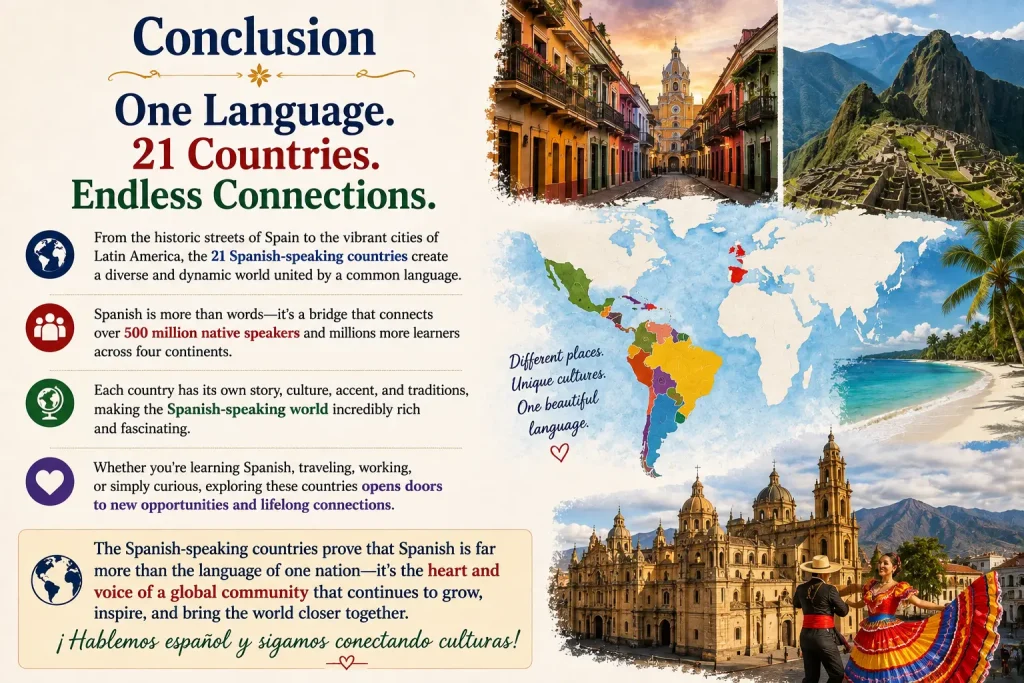
The 21 Spanish-speaking countries prove that Spanish is far more than the language of one nation it’s a global language that connects millions of people across Europe, North America, South America, the Caribbean, and Africa. While every country has its own traditions, cuisine, landmarks, and way of speaking, they all share a language that opens the door to new cultures, friendships, and opportunities.
If you’re just beginning your Spanish journey, don’t stop here. Explore our step-by-step guides on How to Start Learning Spanish, Essential Spanish Vocabulary for Beginners, and others to build a strong foundation. One lesson at a time, you will be ready to communicate confidently across the Spanish-speaking world.
¡Buena suerte y feliz aprendizaje! (Good luck and happy learning!)


