
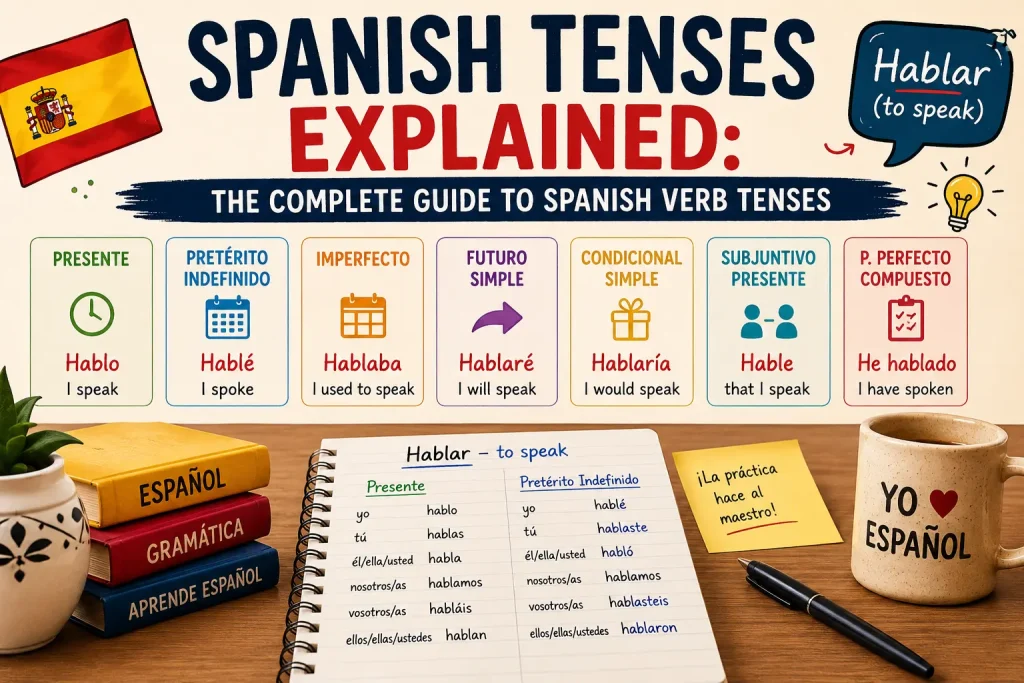
Spanish tenses feel so confusing and overwhelming at first. You struggled to learn hablo, hables, hablé, hablaba, he hablado and just when you thought you were finally getting the hang of it, suddenly someone used completely different form of this verb, for example- hablaria and you are completely stuck.
If you have ever looked at a Spanish verb chart and thought, Why are there so many ways to say the same thing? What does it mean? Why does the verb keep changing? And how are you supposed to know which form to use? Then you are definitely not alone.
But here’s the good news: you don’t need to memorize such big list of conjugations and hope they eventually make sense. Spanish tenses become much easier when you understand why each tense exists, when native speakers use it, and how the meaning changes from one form to another.
By understanding these patterns, Spanish tenses become much easier to recognize and use in real conversations.
If you are new to Spanish grammar, start with our Spanish Grammar Basics for Beginners guide to build a strong foundation before diving deeper into verb tenses.
What Are Spanish Tenses?
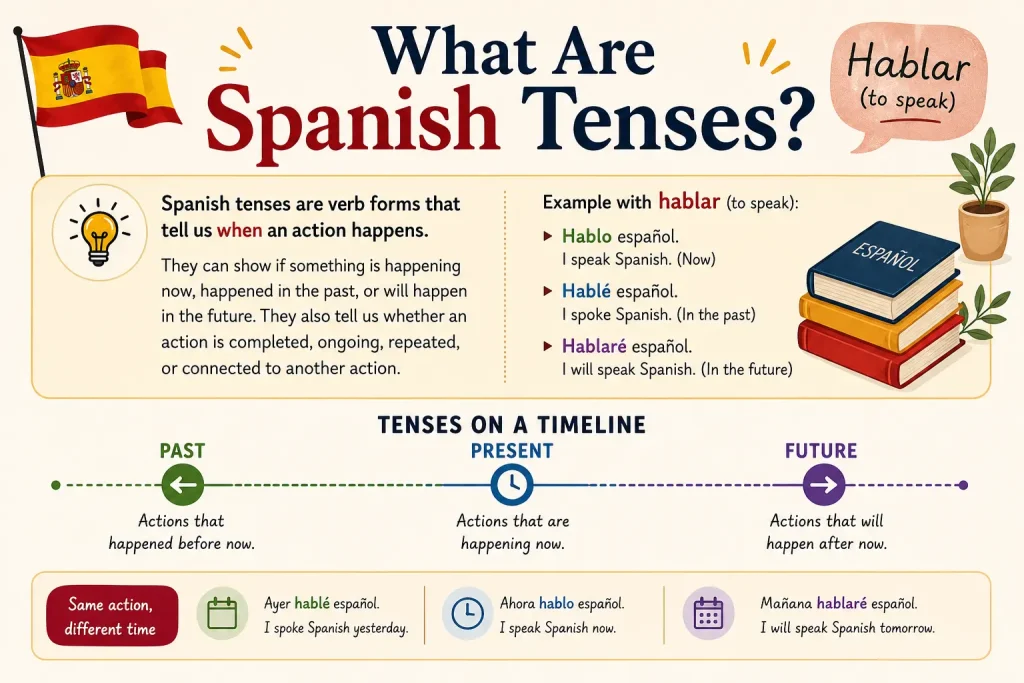
Before we understand different types of tenses, we need to know what tenses actually are. Basically, a verb tense tells us when an action happens whether it is happening now, happened in the past, or will happen in the future.
For example, look at the verb hablar (to speak):
- Hablo español. — I speak Spanish.
- Hablé español. — I spoke Spanish.
- Hablaré español. — I will speak Spanish.
The main action is the same: speaking Spanish. What changes is the time of the action. This is the basic idea behind Spanish tenses: the form of the verb changes to show when or how an action takes place.
However, Spanish tenses can tell us more than just when something happened. They can also help us understand whether an action was completed, ongoing, repeated, or connected to another action. This is why the same verb can appear in many different forms.
So, before we look at each tense in detail, let’s first get a clear picture of the different Spanish tenses and how they are organized.
How Many Tenses Are There in Spanish?
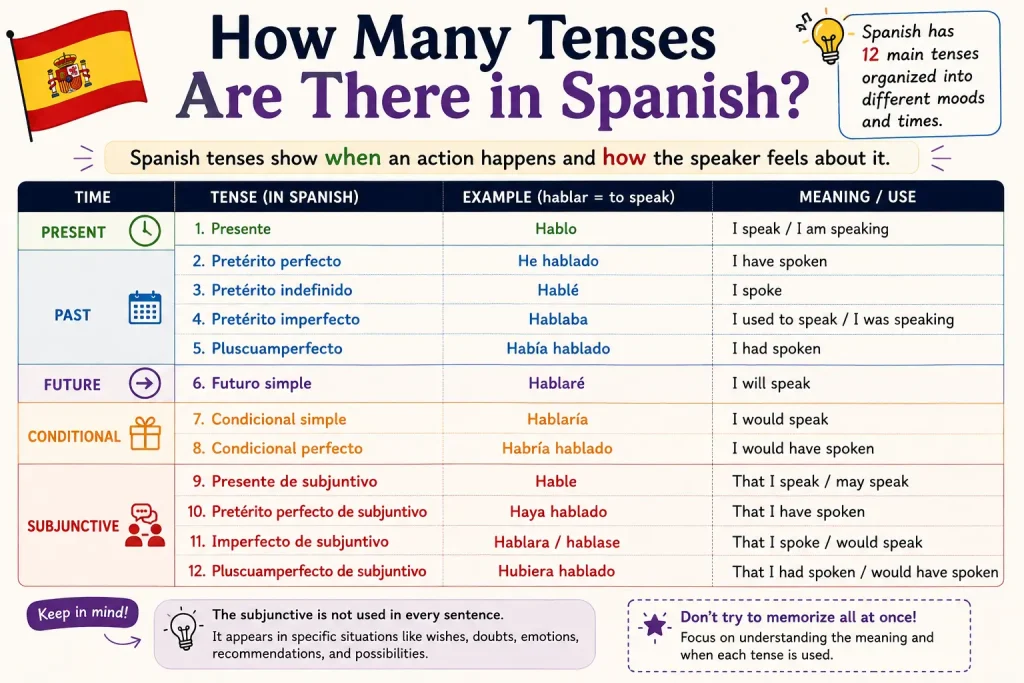
Now, you know what are Spanish tenses, you might be thinking how many different types of tenses are there in Spanish. Spanish has several tenses, and they are organized into different moods, such as the indicative, subjunctive, and imperative.
So, before we look at each tense in detail, let’s first get a clear picture of how Spanish tenses are organized.
| Time | Spanish tense | Example | Meaning |
|---|---|---|---|
| Present | Presente | Hablo | I speak / I am speaking |
| Past | Pretérito perfecto | He hablado | I have spoken |
| Past | Pretérito indefinido | Hablé | I spoke |
| Past | Pretérito imperfecto | Hablaba | I used to speak / I was speaking |
| Past | Pluscuamperfecto | Había hablado | I had spoken |
| Future | Futuro simple | Hablaré | I will speak |
| Conditional | Condicional simple | Hablaría | I would speak |
| Conditional | Condicional perfecto | Habría hablado | I would have spoken |
| Subjunctive | Presente de subjuntivo | Hable | I speak / may speak (subjunctive context) |
| Subjunctive | Pretérito perfecto de subjuntivo | Haya hablado | I have spoken (subjunctive context) |
| Subjunctive | Imperfecto de subjuntivo | Hablara / hablase | I spoke / would speak (subjunctive context) |
| Subjunctive | Pluscuamperfecto de subjuntivo | Hubiera hablado | I had spoken / would have spoken (subjunctive context) |
This Spanish tenses chart is meant to give you a quick overview. You don’t need to memorize all of these forms immediately.
Don’t worry if some of these forms look unfamiliar. You are not expected to memorize everything from this table right away. We will explore each tense step by step, starting with the present and gradually moving into the more complicated forms.
1. Present Tense — El Presente

Let’s start with the easiest and most commonly used Spanish tense: the present tense, or el presente. You will use it constantly in everyday Spanish, whether youare talking about yourself, describing your routine, stating facts, or talking about something happening right now.
The present tense is mainly used to talk about what is happening now, regular or repeated actions, habits, routines, and general facts.
For example:
- Hablo español. — I speak Spanish.
- Estudio todos los días. — I study every day.
- Trabajo desde casa. — I work from home.
- Madrid está en España. — Madrid is in Spain.
How to Form the Present Tense
Spanish verbs usually end in -ar, -er, or -ir in their infinitive form.
For example:
- hablar — to speak
- comer — to eat
- vivir — to live
To conjugate a regular verb in the present tense, you remove the -ar, -er, or -ir ending and add the appropriate ending for the subject.
| Subject | Hablar | Comer | Vivir |
|---|
| Yo | hablo | como | vivo |
| Tú | hablas | comes | vives |
| Él / Ella / Usted | habla | come | vive |
| Nosotros/as | hablamos | comemos | vivimos |
| Vosotros/as | habláis | coméis | vivís |
| Ellos / Ellas / Ustedes | hablan | comen | viven |
When you see a regular verb ending in -ar, -er, or -ir, think:
Remove the ending → add the correct present-tense ending.
Once you understand this basic pattern, you have the foundation for conjugating thousands of regular Spanish verbs. Once you understand the present tense, you have a strong foundation for learning the other Spanish tenses.
2. Spanish Past Tenses
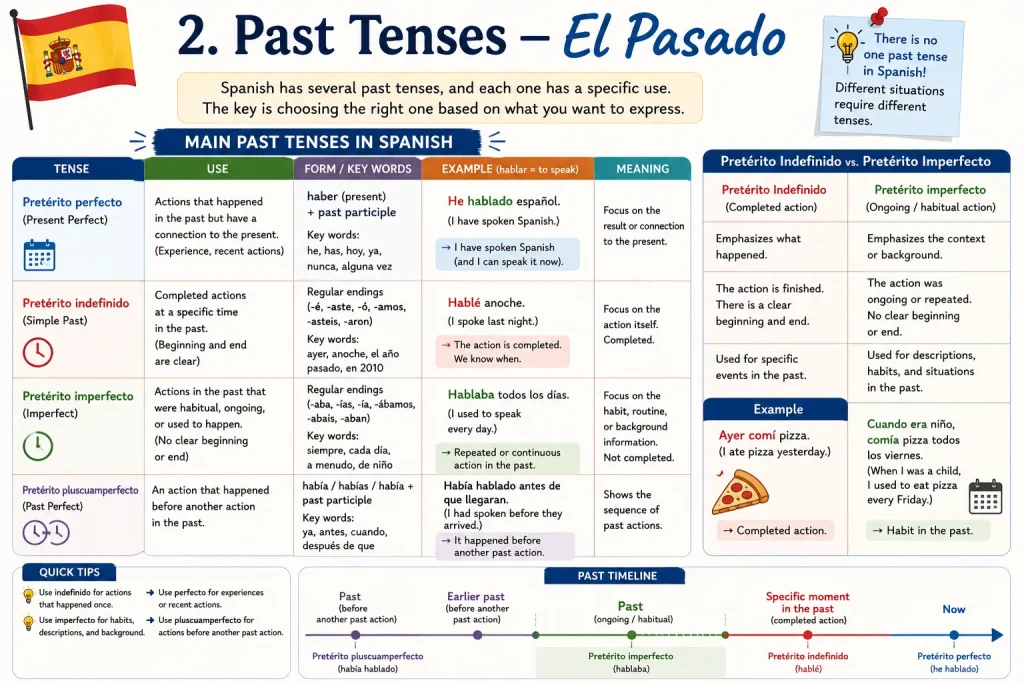
Spanish tenses give us several ways to talk about past events and choosing the right one depends on what you want to express. And choosing the right one depends on what you want to express.
Pretérito Indefinido — Simple Past
It is used to describe actions that happened in past and completed in past. In this, you can answer specifically, when the action happened. For example-
Ayer estudié español. — I studied Spanish yesterday.
Viajé a España el año pasado. — I travelled to Spain last year.
Imperfecto — Imperfect
The imperfecto is used for past habits, repeated actions, ongoing situations, and descriptions. For example-
Cuando era niña, jugaba mucho. — When I was a child, I used to play a lot.
Hacía frío. — It was cold.
Pretérito Perfecto — Present Perfect
The pretérito perfecto describes an action that happened in the past but has a connection to the present. It is formed with haber + past participle. For example-
He visitado Madrid. — I have visited Madrid.
He estudiado mucho esta semana. — I have studied a lot this week.
Pluscuamperfecto — Past Perfect
The pluscuamperfecto describes an action that happened before another action in the past. For example-
- Cuando llegué, ella ya había comido. — When I arrived, she had already eaten.
Here, había comido happened first, and llegué happened afterward.
Pretérito vs. Imperfecto: What’s the Difference?
These are two of the most confusing Spanish tenses for learners. Both pretérito and imperfecto talk about the past, but they show the action in different ways.
| Pretérito | Imperfecto |
|---|---|
| Used for completed actions | Used for ongoing or repeated actions |
| Focuses on what happened | Focuses on what was happening / used to happen |
| Specific or finished events | Habits, routines, or background situations |
| Ayer estudié español. — I studied Spanish yesterday. | Estudiaba español todos los días. — I used to study Spanish every day. |
| Llegué a casa. — I arrived home. | Cocinaba cuando llegaste. — I was cooking when you arrived. |
3. Future Tenses in Spanish
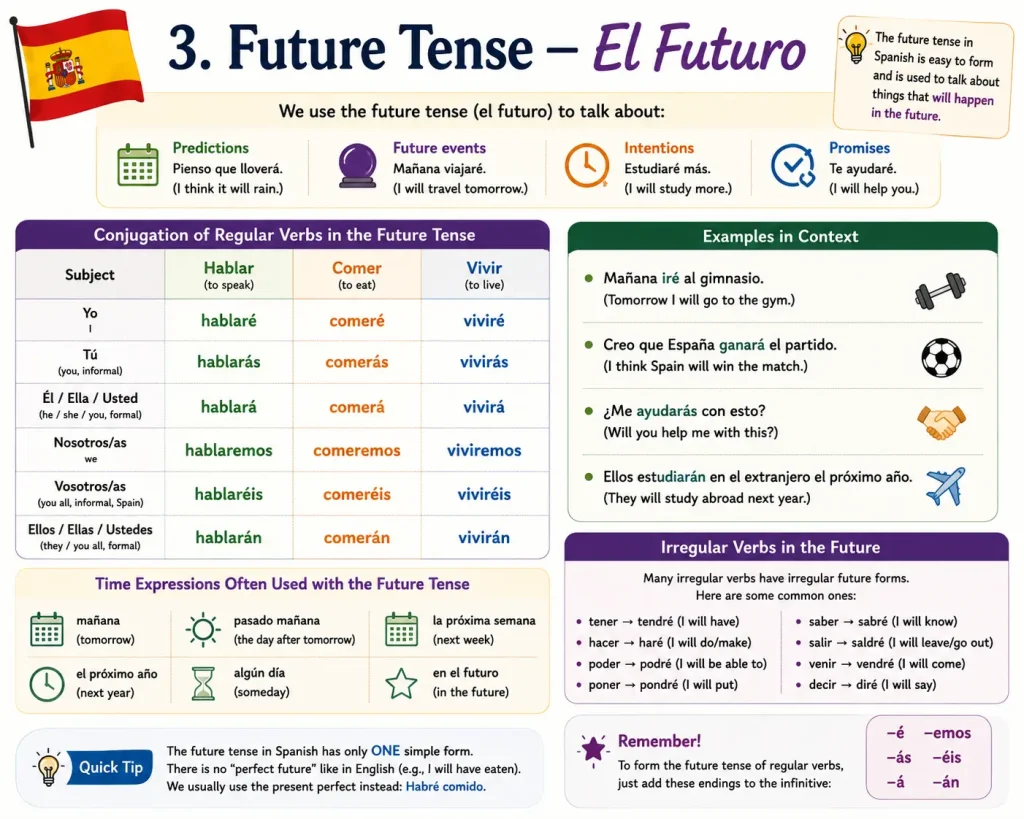
When learning Spanish tenses, you will come across two common ways to express future actions: the simple future and ir + a + infinitive..
Futuro Simple — Simple Future
The futuro simple is used to talk about actions that will happen in the future. In this Spanish tense, we do not remove endings like- ar,er,ir instead add conjucations with whole infinitive form. And it remains same in all 3 forms.
| Subject | Hablar |
|---|
| Yo | hablaré |
| Tú | hablarás |
| Él / Ella / Usted | hablará |
| Nosotros/as | hablaremos |
| Vosotros/as | hablaréis |
| Ellos / Ellas / Ustedes | hablarán |
Ir + a + Infinitive
Spanish also commonly uses ir + a + infinitive to talk about future plans or intentions.
Voy a estudiar español. — I am going to study Spanish.
Vamos a viajar a España. — We are going to travel to Spain.
4. Conditional Tense — El Condicional
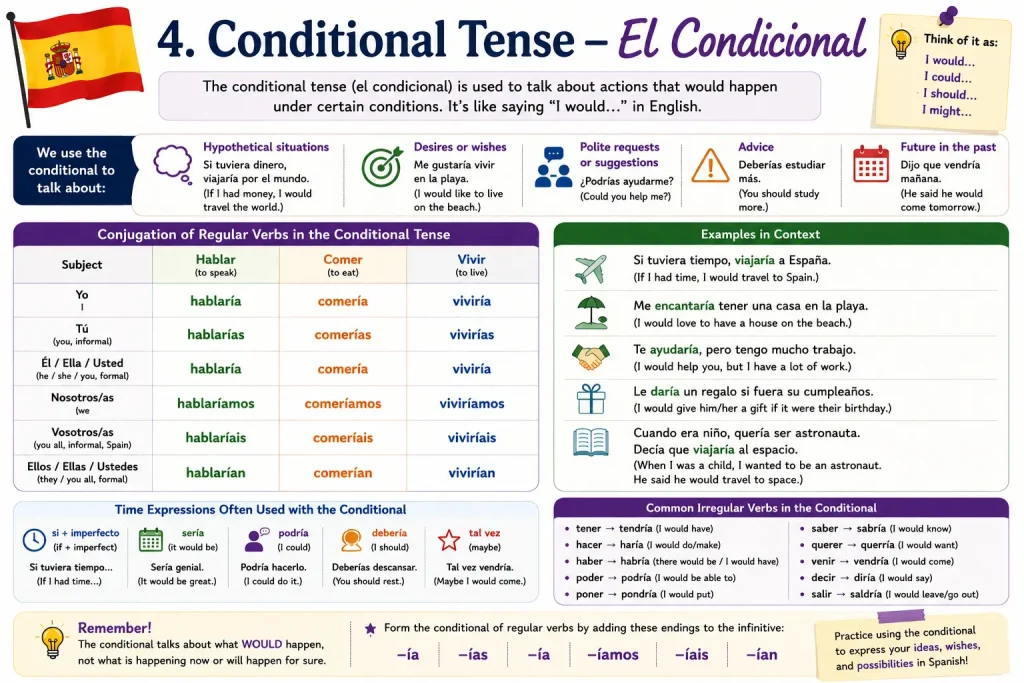
The conditional tense is used when talking about what would happen, what someone would do, or hypothetical situations. It is also commonly used to make polite requests or express wishes.
For example:
- Viajaría a España. — I would travel to Spain.
- Me gustaría aprender español. — I would like to learn Spanish.
- ¿Podrías ayudarme? — Could you help me?
How to Form the Conditional
For regular verbs, simply add the conditional endings to the infinitive.
| Subject | Hablar |
|---|
| Yo | hablaría |
| Tú | hablarías |
| Él / Ella / Usted | hablaría |
| Nosotros/as | hablaríamos |
| Vosotros/as | hablaríais |
| Ellos / Ellas / Ustedes | hablarían |
Conditional Perfect
The conditional perfect describes something that would have happened.
It is formed with:
conditional form of haber + past participle
Habría viajado a España. — I would have travelled to Spain.
5. The Spanish Subjunctive — El Subjuntivo
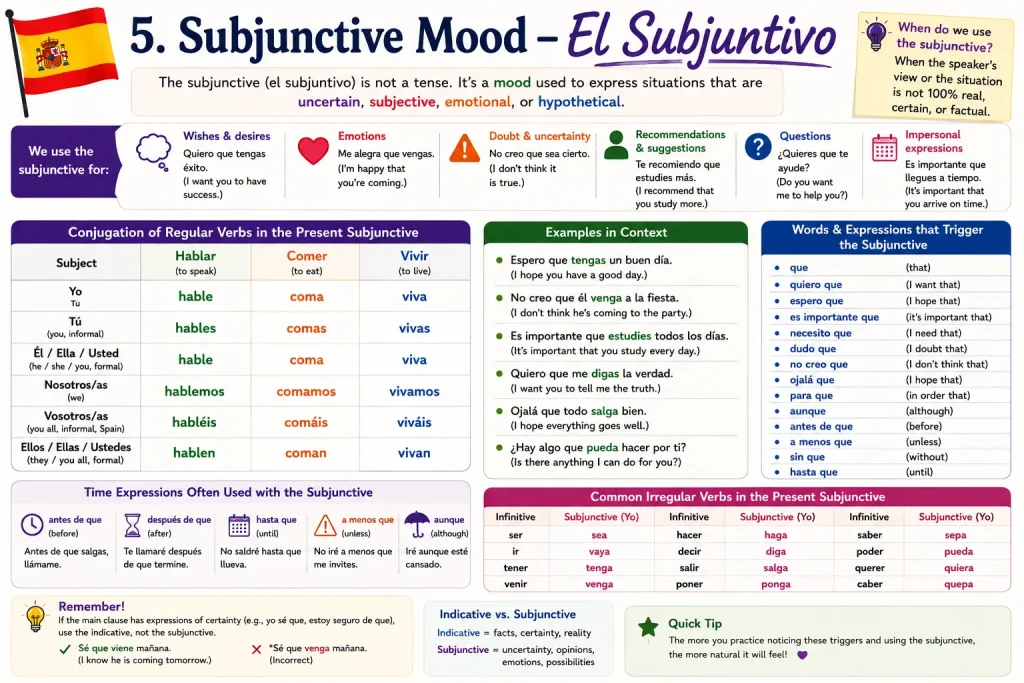
One of the most difficult Spanish tense id the subjunctive.
You need to remember that the subjunctive is not a tense. It is a mood. While tenses mainly tell us when something happens, the subjunctive helps express things such as wishes, doubts, emotions, recommendations, possibilities, and uncertainty.
When Do We Use the Subjunctive?
| Situation | Example |
|---|
| Wish | Quiero que vengas. — I want you to come. |
| Hope | Espero que estés bien. — I hope you are well. |
| Doubt | No creo que sea verdad. — I don’t think it’s true. |
| Emotion | Me alegra que estés aquí. — I’m glad you’re here. |
| Recommendation | Es importante que estudies. — It’s important that you study. |
Common Subjunctive Forms
Spanish has several subjunctive forms:
| Form | Example | Basic meaning |
| Present subjunctive | hable | that I speak |
| Present perfect subjunctive | haya hablado | that I have spoken |
| Imperfect subjunctive | hablara / hablase | that I spoke / would speak |
| Pluperfect subjunctive | hubiera / hubiese hablado | that I had spoken |
Learning Spanish tenses becomes much easier when you combine explanations with actual practice. If you want to check conjugations or explore Spanish grammar further, these resources can help:
- RAE: Check official Spanish conjugation models.
- Instituto Cervantes: Explore Spanish grammar by proficiency level.
- SpanishDict: Look up individual verbs and practice their conjugations.
Conclusion: Spanish Tenses Don’t Have to Be Complicated
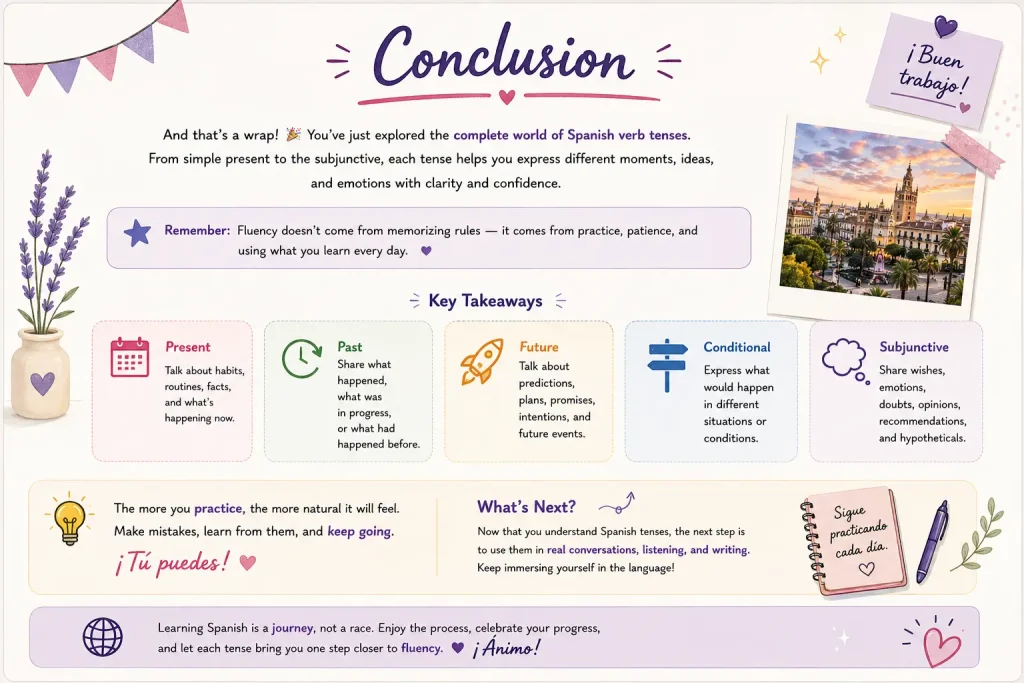
Spanish tenses may seem overwhelming when you first see all the different forms of a verb. But once you understand what each tense is used for, they become much easier to recognize and use.
You don’t need to memorize every Spanish tense in one day. Start with the present, then learn how Spanish talks about the past, followed by the future and conditional. Once you’re comfortable with these, you can gradually work your way into the subjunctive.
The more Spanish you read, hear, write, and speak, the more naturally these differences will start to feel.
You don’t need to know every tense perfectly to start speaking Spanish. You just need to start using the ones you know—and build from there. The key to mastering Spanish tenses is not memorizing everything at once, but understanding when and why each form is used.


