
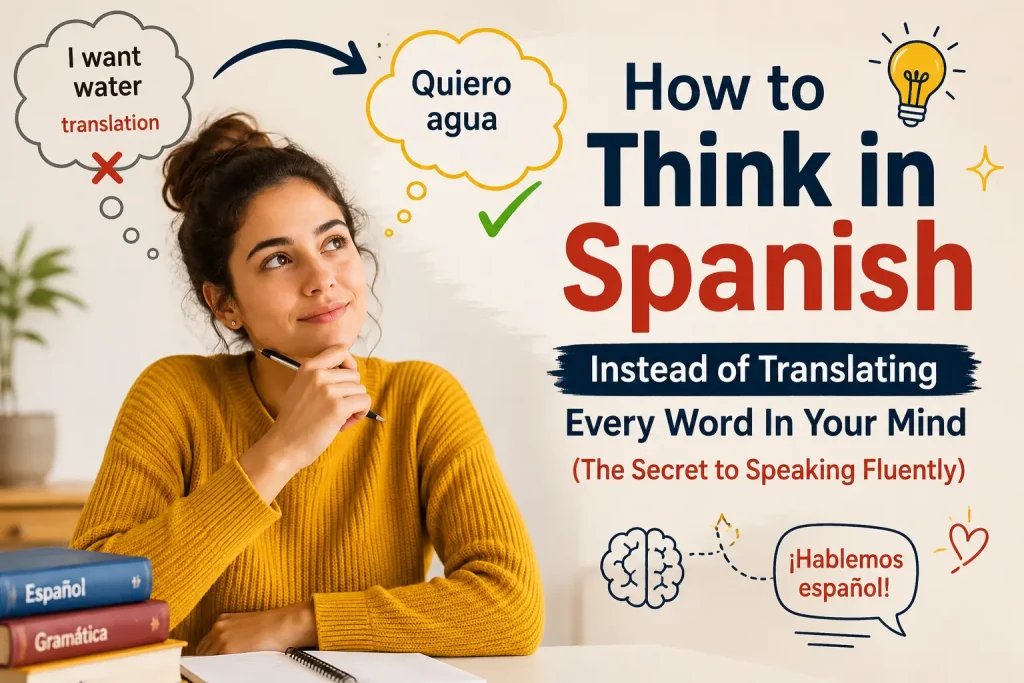
How to think in Spanish without translating word to word from English is one of the biggest milestones every language learner dreams of achieving.
Imagine having your first real conversation in Spanish with a friend, professor or even with native Spaniard. You know what you have to respond or even ask them but when it was actually time to speak up, your mind get frozen. First, you think in English. Then you translate each word into Spanish, afterwards when you need to put those words into sentence, the conversation has already moved on. Frustrating or even embarrassing, isn’t it?
The truth is, fluency is not about memorizing thousands of vocabulary words or mastering every grammar rule it’s about thinking something in Spanish naturally. Once you stop translating and start thinking directly in Spanish, speaking becomes faster, more confident, and far more enjoyable. In this guide, you will discoversome practical techniques that will help you think in Spanish naturally and take a big step toward real fluency.
In this guide, you will discover some practical techniques that will help you learn how to think in Spanish naturally and take a big step toward real fluency.
Why Is It Difficult to Learn How to Think in Spanish?

If you are wondering how to think in Spanish, the first step is understanding why your brain automatically translates any Spanish word in your native language first? Whether your first language is English, Hindi, French, Tamil or any other language, this is a completely natural part of learning.
When you start to learn Spanish, your mind is continously in loop of translating word from your native language to Spanish instead of directly thinking in Spanish. Instead of connecting the Spanish word perro directly with the image of a dog, your brain follows a longer route: perro → your native language → meaning. It might help at the start of your Spanish speaking journey but it ultimately slows down your mind and affects the conversation.
Learning how to think in Spanish means training your brain to directly think in Spanish without translating unnecessary. Fluent Spanish speakers don’t translate every sentence before they speak, they train their mind in a way that they automatically think in Spanish. With consistent practice like regular listening, speaking, reading, and real-life conversations, you will gradually learn how to think in Spanish without translating every word.
Is It Really Possible to Learn How to Think in Spanish?

Yes, of course but it requires efforts and time, it will not happen overnight. If you want to know how to think in Spanis, this skill can be mastered with consistent practice. Just as you naturally think in your native language without translating every word, your brain can gradually learn to process Spanish in the same way.
With consistent practice like regular listening, speaking, reading, and real-life coversations, you will be able to stop translation of every word. Eventually, you will start recognizing common words, phrases, and ideas without mentally translating them into your native language.
And here’s the important part you don’t need to know thousands of words before you can start. In fact, you can begin with the Spanish you already know. Use simple sentences, describe what you are doing or how was your day and talk to yourself in Spanish throughout the day. By these small efforts, Spanish will stop feeling like something you are translating and starts becoming something you’re actually thinking.
7 Practical Ways To Learn How To Think In Spanish
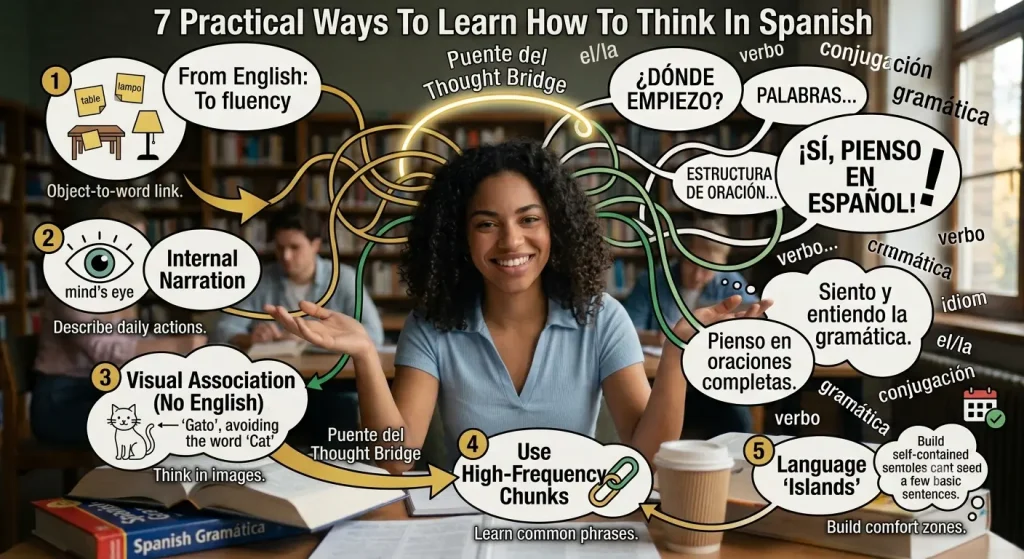
You know you need to stop translating every word in your head. But the biggest question is how? How can you stop translating each word and have a fluent and interesting conversation? You can’t force yourself to “think in Spanish” all day. Instead, you need to give your brain small, repeated opportunities to process Spanish without relying on your native language.
If you have been wondering how to think in Spanish without translating, these seven techniques can help you gradually train your brain to process Spanish more naturally.
1.Stop Translating Every Word
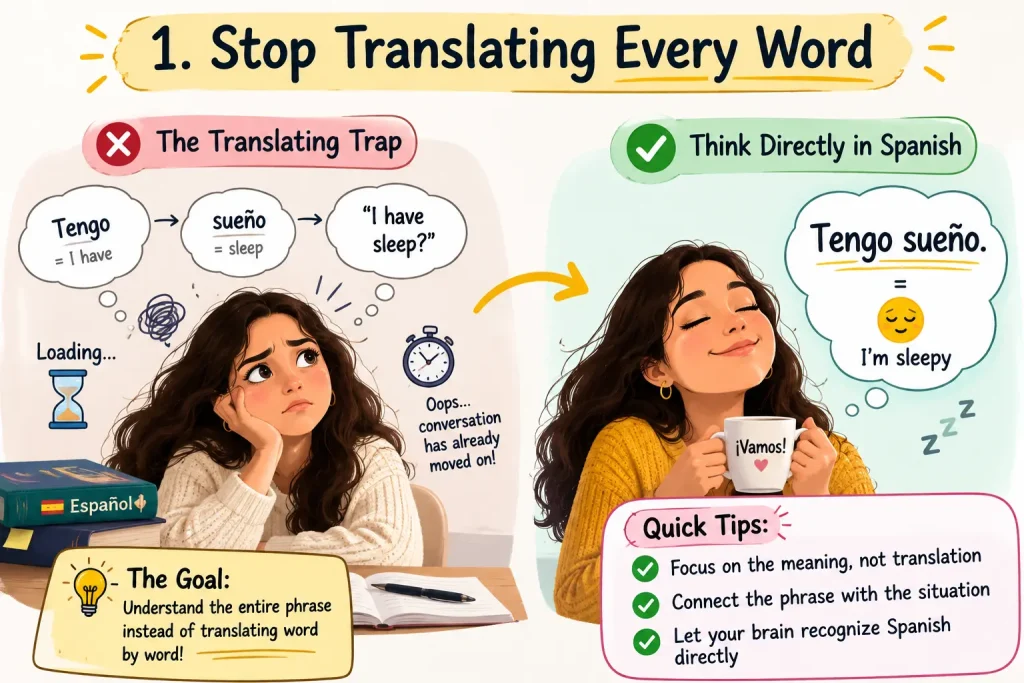
One of the biggest hurdle you face in how to think in Spanish is that you are in a habit to translate every word in your native language first. Instead of translating word by word, try to understand the overall meaning of a sentence.
For example, when you hear:
Tengo sueño. Don’t break it down word bu word like-
Tengo = I have → sueño = sleep → “I have sleep.”
Simply understand the meaning:
“I’m sleepy.”
The goal is to connect the Spanish phrase directly with the idea, feeling, or situation it describes.
2. Learn Word According To Their Context
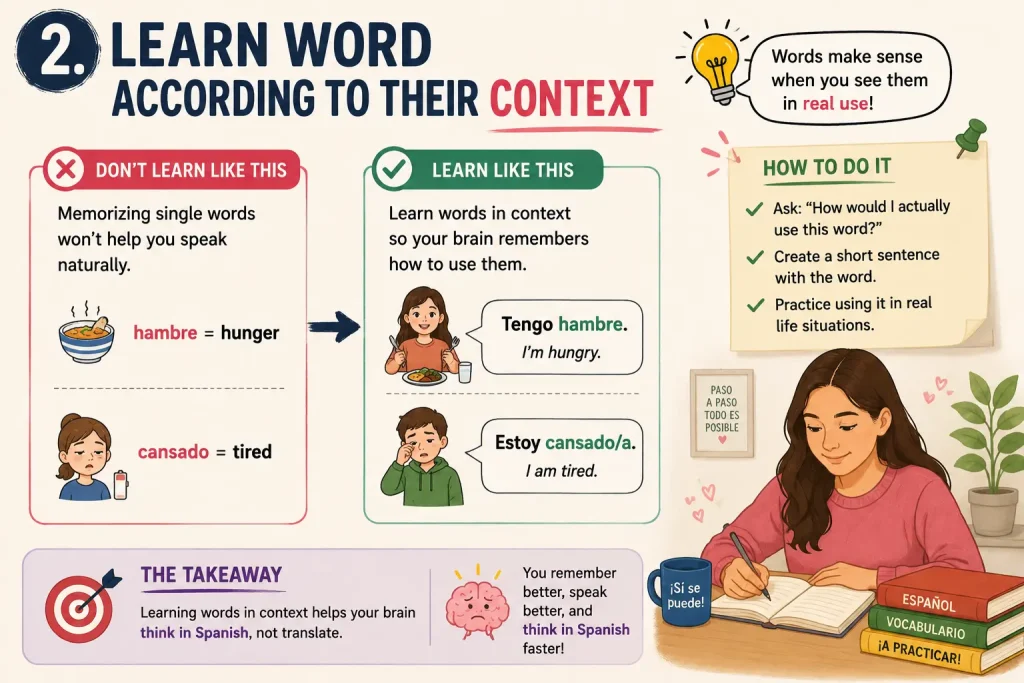
Memorizing random vocabulary might help you in building your Spanish vocabulary, but knowing individual words does not help you in having natural conversations until you know the context.
Instead of learning hambre = hunger. Learn it as: Tengo hambre.
Instead of: cansado = tired . Learn: Estoy cansado/a.
This approach is especially useful when learning how to think in Spanish, because your brain begins to remember complete expressions instead of translations.
When learning new Spanish vocabulary, ask yourself: “How would I actually use this word?” Then create a short sentence with it. With this technique your mind will automatically get used to speak in Spanish instead of translating. For more guidance, check out our guide on Spanish vocabulary.
3. Tell Your Day in Spanish
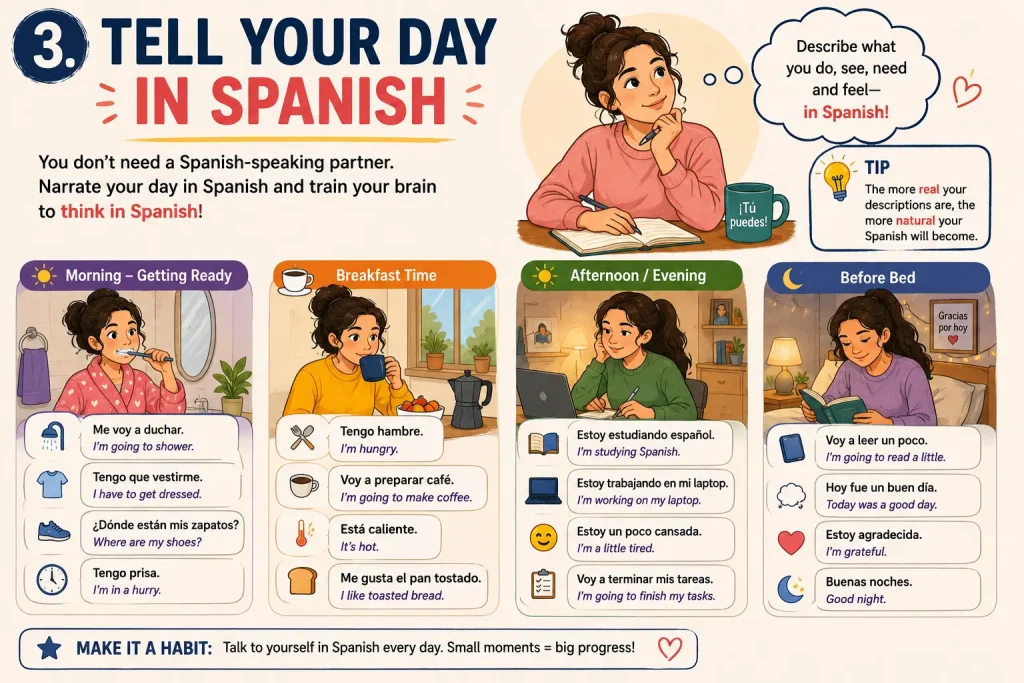
You don’t need a Spanish-speaking partner to practice how to think in Spanish. Your everyday routine can become your practice. You can narrate your day in front of mirror. Or while getting ready in the morning, think:
Me voy a duchar.
Tengo que vestirme.
¿Dónde están mis zapatos?
While making breakfast:
Tengo hambre.
Voy a preparar café.
Está caliente.
This will force your brain to connect real-life situations directly with Spanish instead of going through your native language first.
4. Use Images Instead of Translations

This technique may seem weird, but connect Spanish directly to images. Imagine a picture of an apple. Instead of thinking: apple → manzana.
The same works with actions and situations.
See someone running and think: corriendo
See rain outside and think: Está lloviendo.
See that you are hungry and think: Tengo hambre.
5. Start With Simple Spanish Sentences

One of the common mistake that people do while practicing how to think in Spanish is that they try to make complicated and advanced sentences. But first try to build simple and basic sentences.
Start with:
Tengo que ir al supermercado.
Necesito comprar algunas cosas.
Simple sentences are easier to process and faster to produce. As your confidence grows start with building advanced sentences and connecting them.
6. Surround Yourself With Spanish Every Day

If you only use Spanish during your lessons, your brain has very little opportunity to process the language naturally. Instead of that bring Spanish into your everyday life such as:
- Listen to Spanish music while getting ready.
- Watch Spanish YouTube videos or shows.
- Follow Spanish-speaking creators.
- Change the language of familiar apps to Spanish.
- Listen to Spanish podcasts while walking.
- Read short Spanish posts, articles, or stories.
- Read short Spanish posts, articles, or stories. You can also explore Spanish language learning resources from Instituto Cervantes to get more exposure to authentic Spanish.
7. Speak Before You Feel Ready
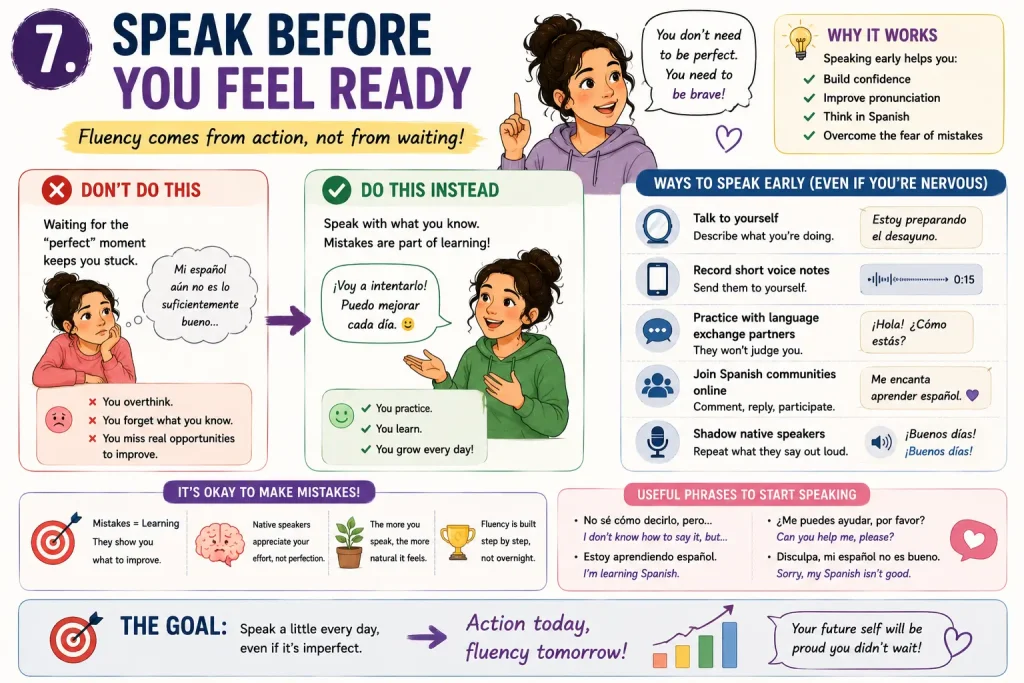
Many learners wait to learn perfect grammar as well as vocabulary before they starts up speaking. When you speak, your brain has to quickly find vocabulary, organize a sentence, choose the correct verb form, and communicate an idea. That repeated process gradually makes Spanish more automatic.
And yes, you’ll make mistakes.
You might say: “Ayer voy al mercado.” Instead of: “Ayer fui al mercado.”
That’s okay. The mistake shows you what you need to improve. The goal is not about having perfect Spanish. The goal is to make your brain trained to think in Spanish without waiting for a translation.
Common Mistakes That Stop You From Thinking in Spanish

Learning how to think in Spanish is not about completely avoiding your native language. It’s about gradually reducing your dependence on it. However, there are some mistakes that people make which generally slower down their progress.
- Translating word by word.
- Waiting to become perfect in grammar and then start to speak.
- Just memorizing random Spanish words that they might not even use in daily conversations.
- Knowing Spanish vocabulary but not using them in their conversations.
- Only practicing during study sessions.
Conclusion
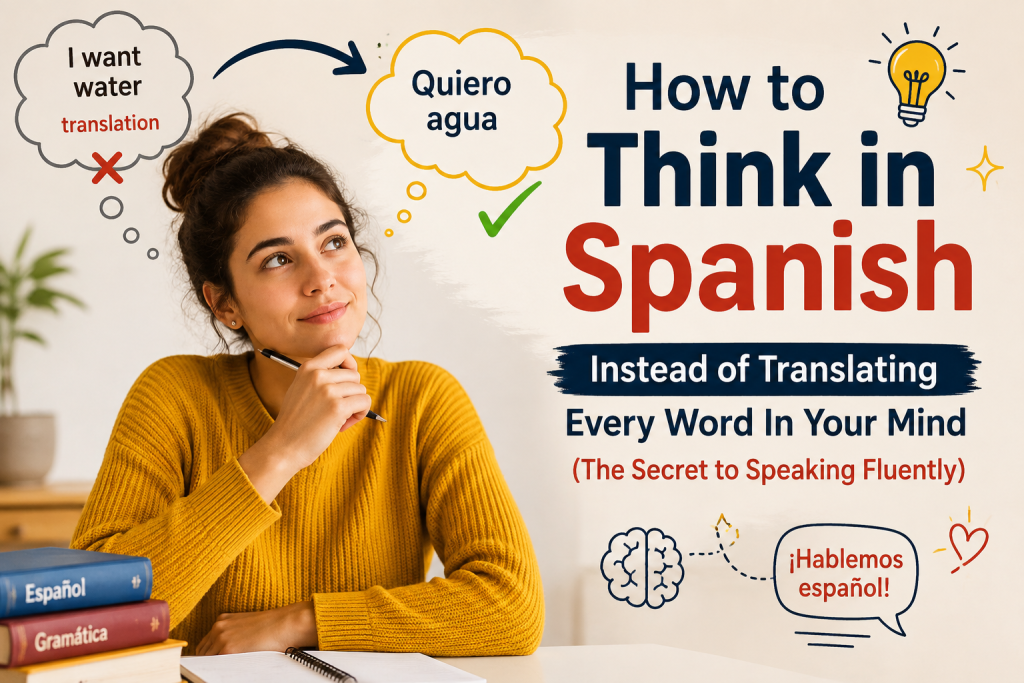
Learning how to think in Spanish is not about forgetting your native language overnight. It’s about slowly teaching your brain to connect Spanish directly with ideas, situations, and feelings.
Take small steps. Stop translating phrases word by word, describe your day in Spanish, learn vocabulary in context, and give yourself regular opportunities to listen and speak. You will make mistakes and that’s completely normal. Every time you choose Spanish instead of looking for it’s translation, you are one step ahead to become fluent in Spanish and holding up conversations.
The goal is not to think perfectly in Spanish. The goal is to think in Spanish a little more naturally every day.


One Response