
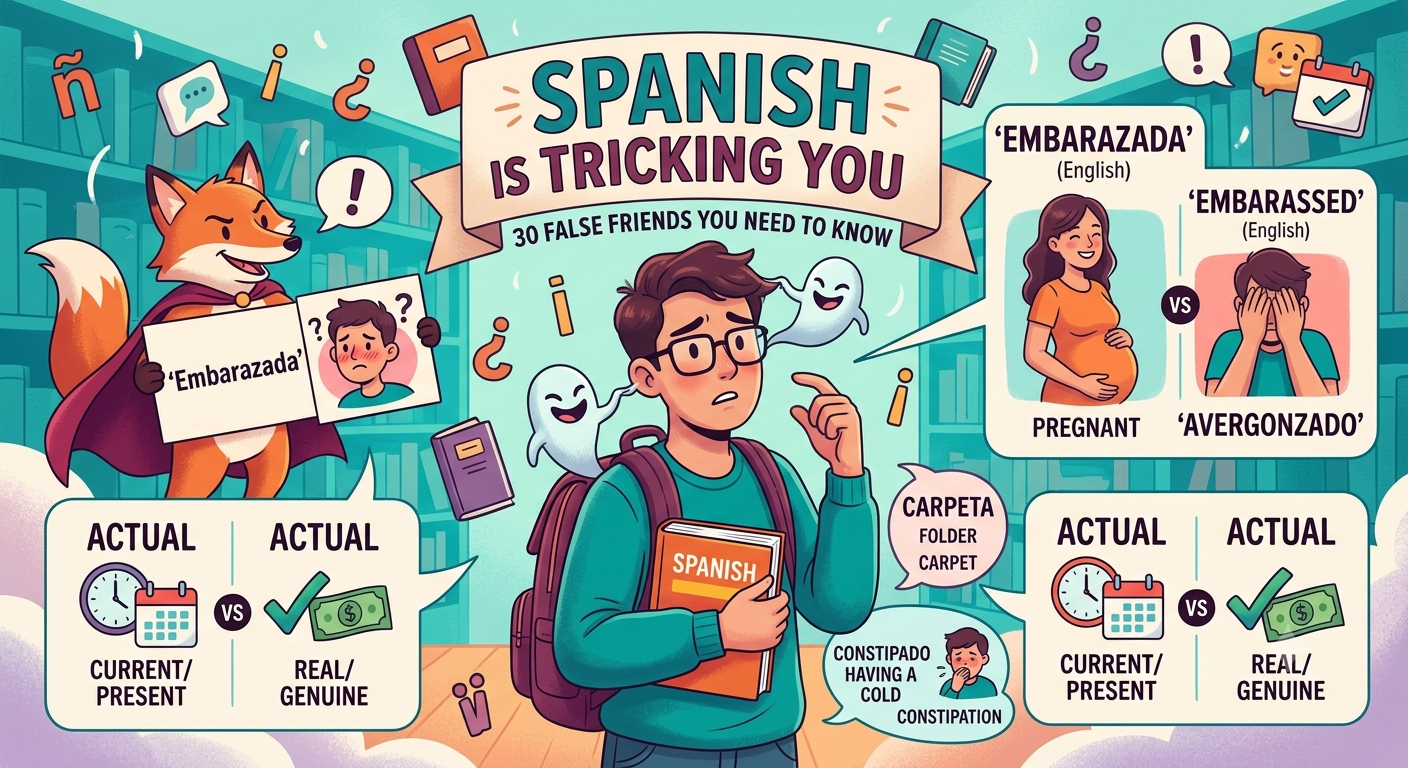
Spanish false friends can make you sound fluent one second and accidentally say something completely different the next. Many of us have defintely faced this problem where we might have said something that we made our fun out of it.
You see a Spanish word that looks almost same as English and think, “Easy, I know this one!” but Spanish has other plans. One tiny assumption can turn “I’m embarrassed” into “I’m pregnant,” or “I’m going to the library” into a trip to the bookstore.
These tricky words are everywhere, and once you start noticing them, you will realize just how easily English can fool you in Spanish. So, before another familiar looking word tricks you, let’s know 30 Spanish false friends you absolutely need to remember.
What Are Spanish False Friends?
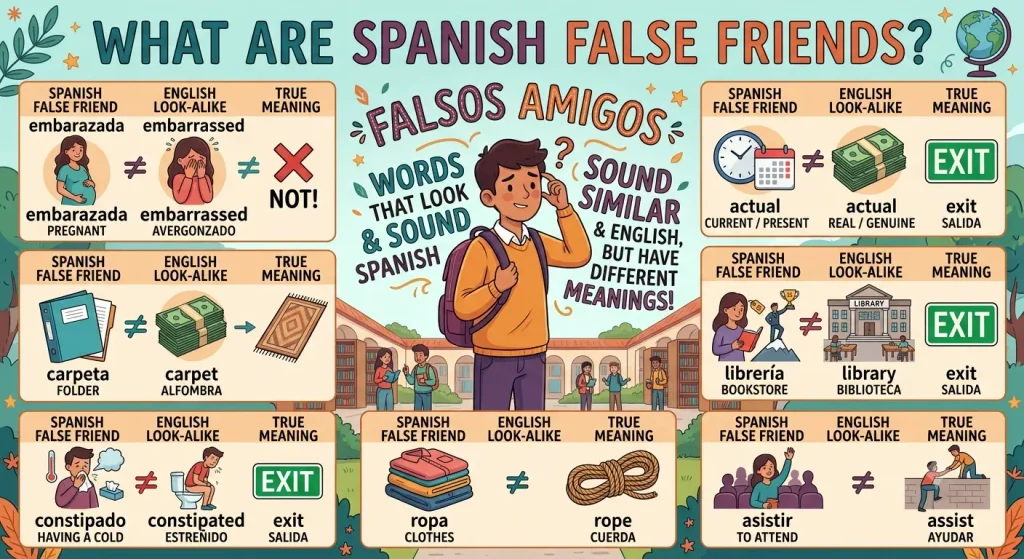
Before diving into 30 false friends, we need to know what it actually means. Basically these are the words that look or sound similar to an English word but have a completely different meaning in Spanish. They are called “false friends” because they seem familiar enough to trust but they can easily mislead you.
Take éxito, for example. It looks a lot like the English word exit, but it actually means success. Or carpeta, which may remind you of carpet, but in Spanish it means folder.
These words are especially tricky because your brain naturally tries to connect new Spanish vocabulary with words you already know in English. The good news? Once you learn the most common false friends, they become much easier to recognize and remember.
False friends are a common challenge for Spanish learners, and the British Council also highlights how similar looking English and Spanish words can have completely different meanings.
False Friends vs. Cognates: What’s the Difference?
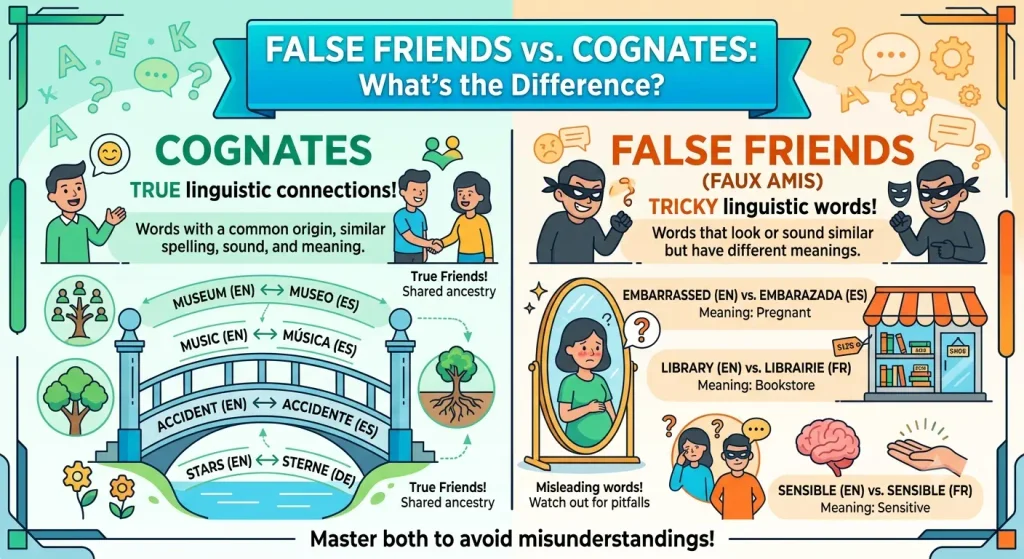
Not every Spanish word that looks like an English word is trying to trick you. Some are actually cognates. They are the words that look similar and have the same or very similar meaning in both languages.
For example:
Spanish: animal
English: animal
Meaning: the same.
But then you have false friends:
Spanish: éxito
Looks like: exit
Actually means: success
That small difference is what makes false friends so tricky. Your brain sees a familiar looking word and automatically connects it to English, even when Spanish has given the word a completely different meaning.
And now that you know the difference between false friends and cognates, it’s time to meet the words that cause the most confusion.
30 Spanish False Friends You Need to Know
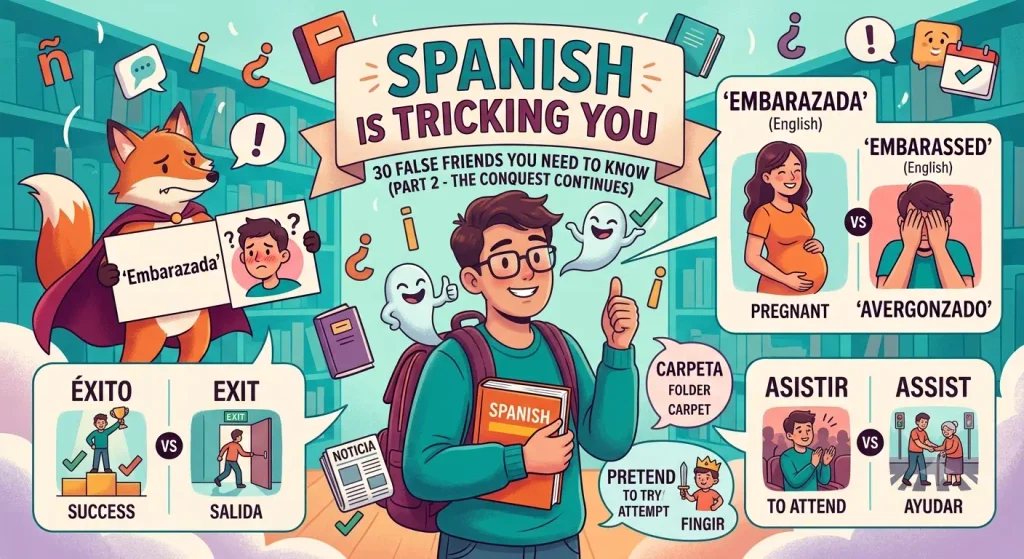
Some of these words look so much like English that your brain will want to translate them automatically. Don’t. Take a second, look at the real meaning, and pay attention to the example sentence.
Here are 30 Spanish false friends every Spanish learner should know.
| # | Spanish Word | Looks Like / Confused With | What It Actually Means | Example |
|---|---|---|---|---|
| 1 | Embarazada | embarrassed | pregnant | Mi hermana está embarazada. → My sister is pregnant. |
| 2 | Éxito | exit | success | La película fue un éxito. → The movie was a success. |
| 3 | Carpeta | carpet | folder | El documento está en la carpeta. → The document is in the folder. |
| 4 | Librería | library | bookstore | Compré este libro en una librería. → I bought this book at a bookstore. |
| 5 | Asistir | assist | to attend | Voy a asistir a la clase. → I’m going to attend the class. |
| 6 | Actual | actual | current / present | Esta es mi situación actual. → This is my current situation. |
| 7 | Actualmente | actually | currently / at present | Actualmente vivo en Madrid. → I currently live in Madrid. |
| 8 | Sensible | sensible | sensitive | Es una persona muy sensible. → She is a very sensitive person. |
| 9 | Constipado/a | constipated | having a cold | Estoy constipado y tengo tos. → I have a cold and a cough. |
| 10 | Ropa | rope | clothes | Necesito comprar ropa nueva. → I need to buy new clothes. |
| 11 | Sopa | soap | soup | La sopa está muy caliente. → The soup is very hot. |
| 12 | Largo/a | large | long | El viaje fue muy largo. → The journey was very long. |
| 13 | Fábrica | fabric | factory | Mi padre trabaja en una fábrica. → My father works in a factory. |
| 14 | Realizar | realize | to carry out / accomplish | Tenemos que realizar el proyecto. → We have to carry out the project. |
| 15 | Recordar | record | to remember | No puedo recordar su nombre. → I can’t remember his name. |
| 16 | Pretender | pretend | to intend / plan / aim | Pretendo estudiar en España. → I intend to study in Spain. |
| 17 | Pariente | parent | relative | Tengo un pariente en Barcelona. → I have a relative in Barcelona. |
| 18 | Decepción | deception | disappointment | Fue una gran decepción. → It was a big disappointment. |
| 19 | Molestar | molest | to bother / annoy | ¿Te molesta el ruido? → Does the noise bother you? |
| 20 | Colegio | college | school | Mis hijos van al colegio. → My children go to school. |
| 21 | Vaso | vase | drinking glass | Quiero un vaso de agua. → I want a glass of water. |
| 22 | Carta | cart | letter / menu / card | Escribí una carta a mi amiga. → I wrote a letter to my friend. |
| 23 | Firma | firm | signature | Necesito tu firma aquí. → I need your signature here. |
| 24 | Lectura | lecture | reading | La lectura es importante para aprender idiomas. → Reading is important for learning languages. |
| 25 | Atender | attend | to assist / serve / pay attention | La enfermera atendió al paciente. → The nurse attended to the patient. |
| 26 | Introducir | introduce | to insert / put in | Introduce la tarjeta en la máquina. → Insert the card into the machine. |
| 27 | Soportar | support | to tolerate / put up with | No puedo soportar este ruido. → I can’t stand this noise. |
| 28 | Suceso | success | event / incident | El suceso ocurrió ayer. → The incident happened yesterday. |
| 29 | Idioma | idiom | language | ¿Qué idioma hablas? → What language do you speak? |
| 30 | Exquisito/a | exquisite | delicious / excellent | El postre estaba exquisito. → The dessert was delicious. |
Notice a pattern?
Spanish is not necessarily making these words difficult. English is making them look familiar.
That is exactly why false friends can confuse us and actually make our fun.
The Most Confusing Spanish False Friends

Not all Spanish false friends are equally confusing. But there are some worth mentioning words that appears in everyday conversations and are easy to misinterpret.Take embarazada, for example. It is one of the most famous false friends because it looks almost identical to embarrassed, but it actually means pregnant.
Similarly, constipado/a usually refers to having a cold, not being constipated.
Then there’s librería, which means bookstore, while biblioteca is the word for a library.
These examples show why translating word for word from English can sometimes lead you in the wrong direction and it tells you importance of thinking a word in one language instead of translating it from another language. And if you want to know how exactly you should think in spanish, do read our blog on How to Think in Spanish Instead of Translating Every Word In Your Mind.
How to Avoid Spanish False Friends
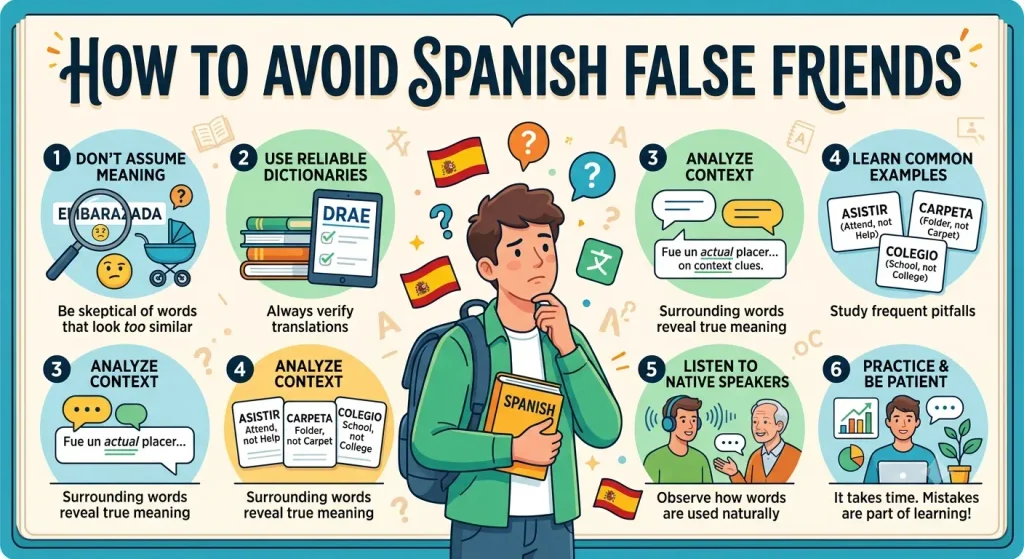
You don’t need to memorize hundreds of confusing words to avoid false friend mistakes. A few simple habits can make a big difference.
1. Don’t Translate Every Word Directly
One of the biggest mistakes beginners make is translating Spanish word for word into English. This can work for some vocabulary, but it becomes risky when you encounter a false friend.
Instead of thinking:
Éxito = exit
train yourself to remember:
Éxito = success
2. Learn Words in Context
A word becomes much easier to remember when you see how native speakers actually use it.Instead of memorizing:
Librería = bookstore
remember a complete sentence:
Voy a la librería a comprar un libro.
I’m going to the bookstore to buy a book.
3. Learn the Correct Alternative Too
Don’t only memorize what a false friend doesn’t mean. Learn the word you actually need.
For example:
Embarazada = pregnant
Avergonzada = embarrassed
Librería = bookstore
Biblioteca = library
Éxito = success
Salida = exit
This makes it much easier to choose the right word when you’re speaking.
4. Keep Your Own False-Friends List
Whenever you discover a new confusing word, add it to a small list in your Spanish notes. Write the Spanish word, the English word it resembles, its real meaning, and one example sentence.
5. Don’t Be Afraid of Mistakes
False friends can lead to some funny mistakes, but making them is completely normal. Every learner has moments when they use a word incorrectly because it looks familiar.
The important thing is to notice the mistake, learn the correct meaning, and use it correctly next time. In fact, the awkward ones are often the easiest to remember! The more you encounter Spanish through conversations, books, videos, podcasts, and everyday situations, the more naturally these distinctions will become.
Conclusion

Spanish false friends may seem confusing at first, but once you know the most common ones, they become much easier to recognize. The key is to stop assuming that a familiar-looking Spanish word has the same meaning as its English counterpart. Instead, pay attention to context, learn words through real sentences, and remember the correct Spanish meaning.
Learning Spanish is not about getting every word perfect from day one. It’s about noticing, learning, and trying again. So the next time a Spanish word looks suspiciously familiar, take a second before trusting it you might just have discovered another false friend.
Keep exploring Spanish, keep making mistakes, and most importantly, keep speaking. ¡Nos vemos en Hispanova!


